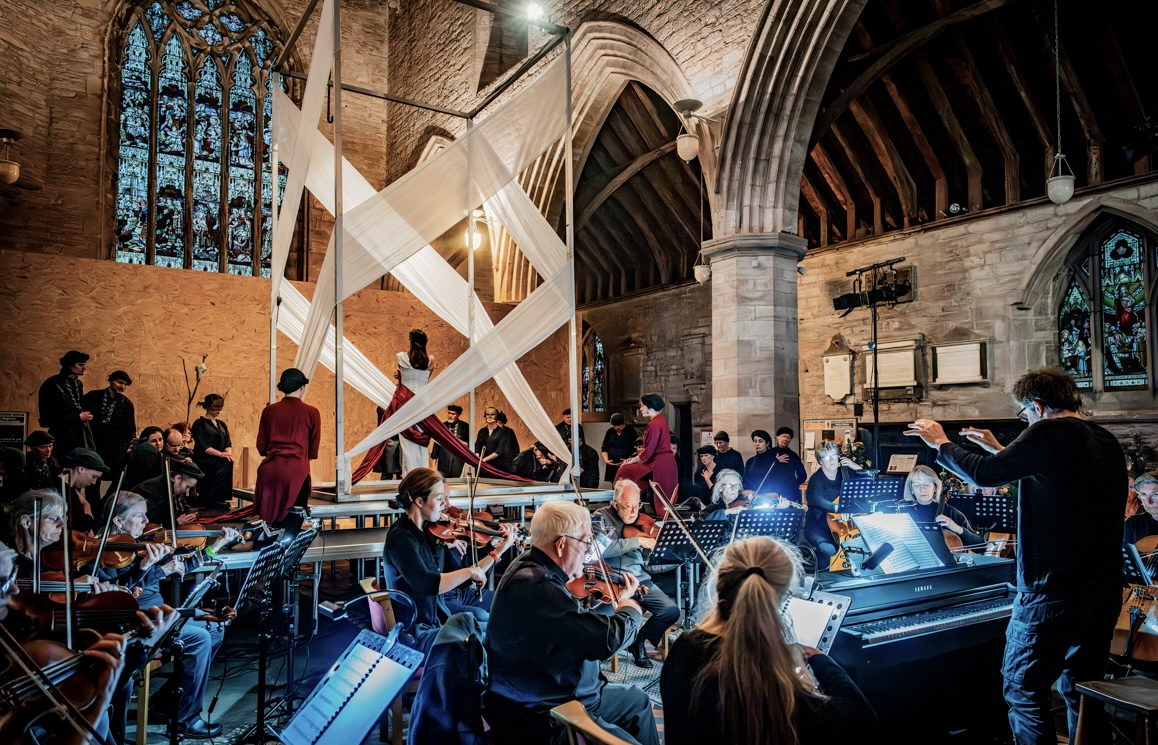
n the luminous stone sanctuary of 11th-century Brecon Cathedral, listening to one of opera’s earliest masterpieces, it was hard not to reflect on how unforgiving the 21st century has been to the art form. Yet Mid Wales Opera’s OpenStages production of Dido and Aeneas offered something increasingly rare in our cultural life: not merely reassurance, but a persuasive sense of artistic continuity and, in the hopeful light of Eastertide, a flicker of renewal.
If Covid dealt a devastating blow to opera, the years that followed have proved scarcely kinder. The promised post-pandemic recovery never fully materialised. Instead, as vaccines were administered into the body politic, another more metaphorical syringe seemed to be draining life from the publicly funded arts sector. Opera, always dependent on public subsidy, has too often been left hovering on life support.
Yet requiring public sector funding, an artistic malaise set in predating lockdown. Across Britain, publicly funded companies had already begun to drift, often due to tick-box necessity, small but vocal pressure group agitation, into forms of programming and production design that smacked of social engineering and left parts of their core audience feeling alienated.
Covid ended the careers of many self-employed performers not able to get government help that kept the publicly funded companies alive if in hibernation. Yet post-Covid, funding bodies have simply turned down the dial on the life-support machine. In Wales, the squeeze on Welsh National Opera has rightly drawn headlines. But the withdrawal of support from Mid Wales Opera was, in many ways, even more perverse.
For this is a widely touring company with genuine public affection, giving Welsh talent much needed opportunities. Ticket sales grew, audiences remained loyal, donors stepped in, and alternative streams of public support were found. Mid Wales Opera survived, just, though not unchanged. Audiences beyond mid Wales will feel the consequences of those cuts this autumn. Or, more pointedly, they simply will not feel them at all.
Which makes what happened in Brecon all the more significant. Given twice, in afternoon and evening performances, that made full use of the cathedral’s resonant beauty, this was far more than a single operatic event. It marked the culmination of an impressive week of music-making across Brecon and Hay-on-Wye, drawing together music students, amateur players, a notably large chorus and experienced professionals in a shared act of music-making.
Under the characteristically assured musical direction of Jonathan Lyness and the deft, intelligent staging of Richard Studer, the result was remarkable for its clarity, polish and emotional truth. That such coherence emerged from so short a rehearsal period was itself an achievement. More importantly, what emerged felt fresh, generous and vividly alive: a testament not only to Mid Wales Opera’s resourcefulness, but to the enduring appetite for opera well beyond the structures of large, grant-dependent institutions.
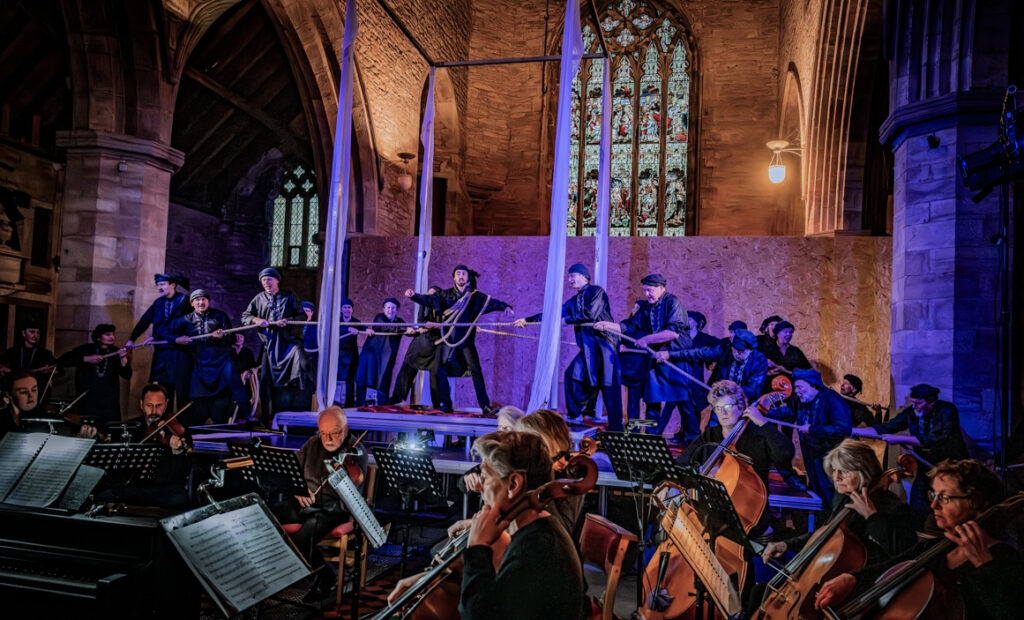
Purcell’s compact masterpiece depends less on spectacle than on emotional candour, and this production understood that instinctively. The cathedral’s intimate grandeur proved the ideal setting for the opera’s trajectory from courtly grace to supernatural menace and final devastation. The chorus was deployed with admirable theatrical intelligence: elegant courtiers in one moment, eerie emissaries of the underworld in the next, then bright, swaggering sailors, all achieved through subtle shifts of gesture, posture and vocal colour. Richard Studer’s staging was spare but eloquent: a raised platform framed by lengths of red and white fabric that were twisted, drawn and transformed to suggest power, fate and passion. Dido’s stylised unravelling was especially effective.
At the centre was a poised and deeply affecting Dido from Kathy Macaulay, whose warm, finely shaded soprano combined richness of tone with emotional restraint. Her final lament was beautifully judged: noble rather than indulgent, all the more moving for its simplicity. Opposite her, Joshua Lane brought heroic ardour and lyrical warmth to Aeneas, and if he was battling a head cold, it scarcely registered beyond a slight edge to the tone.
Louise Wood was a commanding Sorceress, sharply characterised and vocally incisive, relishing Purcell’s darkly seductive writing. Erin Wynne Thomas, as Second Witch, and Grace Wexler, as First Witch, brought vivid personality and fine ensemble discipline to the scenes of mischief and malice. Alaw Grug Evans made an engaging Belinda, singing with freshness and musical poise, while Heini Hughes, as Second Woman, brought sensitivity and grace. Sebastien Sgouraditis, meanwhile, made a stylish and charming cameo as the Sailor.
Most heartening of all was the calibre of these emerging performers. Several are already beginning to establish themselves on opera and concert stages, and together they offered eloquent proof of the depth of young vocal talent emerging from Britain’s conservatoires and royal colleges.
Special praise, too, must go to the players, led with distinction by Elenid Owen, Sue Brown, Jenny Cavan, David Cooper, Stella Elliot, Olivia Geddes, Jean Lennox, Wendy Lund and Matthew Silver (violins); Hugh Dunthorne and Dorcas Wedmore (violas); Ann Downing, Clare Fisher, Annie Nethercott and Patricia Price (cellos); and Jennifer Morris (double bass) with Purcell’s score. At a time when opera in Wales can sometimes feel as though it has disappeared down a disused pit shaft, this production sounded a clear and hopeful note.
That matters. WNO remains diminished in scale, having lost musicians and chorus while still receiving substantial, if regrettably reduced, public funding and having lost big name artistic leaders who, often controversial, made the company punch above its weight.
Recent seasons have too often been defined by retrenchment, shockingly sparce performances, illuminated only occasionally by flashes of excellence. It would be unthinkable that the first opera of 2026 was not until April, and that a revival of a fun Carry on up the Valleys sort of show from last year.
One can only hope that this week’s new production of The Flying Dutchman, in the hands of Jack Furness and under the musicianship of Tomáš Hanus, proves a genuine triumph. More importantly, fingers must remain crossed that the forthcoming season announcement restores some ambition and substance to what was once one of Europe’s most admired opera companies, even when facing precarious financial challenges.
Against that backdrop, Mid Wales Opera’s work feels not merely welcome, but essential. This modestly scaled enterprise, uniting amateur commitment with professional leadership, was proof of what can still be achieved through imagination, courage and community belief.
The good news is that Mid Wales Opera’s professional SmallStages company returns to Brecon this autumn with Gianni Schicchi. It is all the more regrettable that Arts Council cuts will prevent the company from visiting some of its usual touring venues. Even so, here in rural Wales, opera is not merely surviving it is retaining its voice and nurturing the future.
The company’s next event is a fund raising annual garden concert with Charlotte Forrest and her ensemble of singers on Sunday, 5th July 2026, at 6pm giving a concert full of myths and morals.
Thanks to the generosity of Kingsley George and Wolfgang Schaeffer, Mid Wales Opera returns to the wonderful garden at Cwm Weeg, near Newtown.
A colourful bandstand provides cover for the concert in case of rain; tea and coffee will be available during the long picnic interval.
Sunday 5 July 6pm
Cwm Weeg, nr Newtown
Tickets: £20 adult, £5 child
Book at Hafren Box Office: 01686 948100
https://thehafren-tickets.thehafren.co.uk/ticketbooth/shows/873684671
https://www.midwalesopera.co.uk
Images by Stephen Cain
