How do you adapt The Flying Dutchman for 2026? Wagner’s shortest opera is not a frequent flyer to contemporary stages, perhaps, for understandable reasons; it is deeply steeped in the Romantic iconography and storytelling, with a pervasive undertone of Christian moralising that doesn’t help things at all, and thus may sound alien to a contemporary audience. Besides, stories of undead pirates and ghost ships have long been relegated to the field of sheer entertainment (it is not by chance that one of the few semi-recent popular culture media to be directly influenced by Dutchman was none other than the Pirates of the Caribbean cinematic trilogy). At the same time, the story is so grounded in that iconography, and that storytelling, that imagining it transposed to any other setting is a rather contrived process. Looking at the opera on paper, the first issue coming to mind is undoubtedly that of relatability. Yet the WNO, coming back with a new season which is by necessity much abridged, has never been a strange to revisiting paths less trodden in its choice of which operas to bring to the stage. I will admit that I was at first somewhat concerned to see the first characters on stage dressed in contemporary attire, precisely because the Dutchman story feels like one that has little to ground itself in once moved to a modern setting. But the Dutchman himself, after all, has been at sea for hundreds of years; once he and his crew show up in full age-of-sails regalia, the contrast strikes harder, and makes the whole staging work.
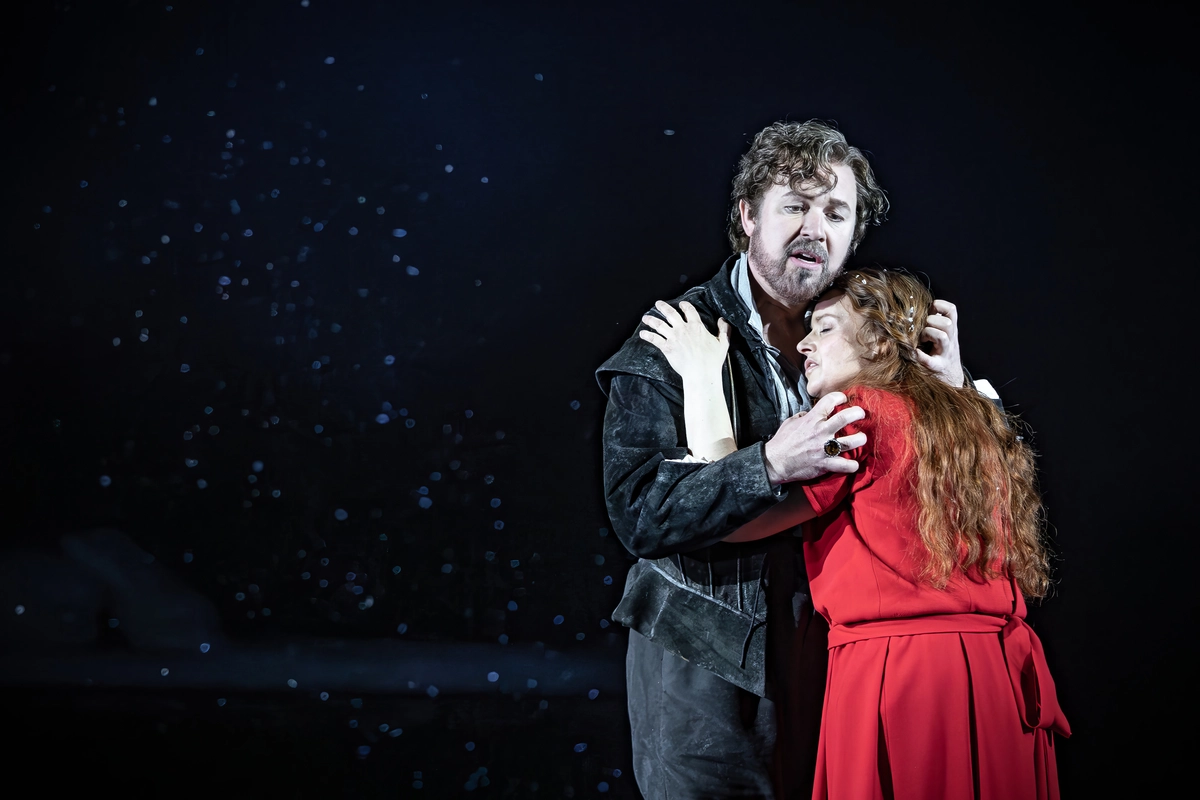
Director Jack Furness had a very good intuition when it came to presenting this opera: in spite of its title, the true protagonist is not the Dutchman himself, but rather Senta, the young woman who falls in love with his tale of woe even before she meets him, dreams of being the one to redeem him, and eventually pays the ultimate price to do so. Thus we have now a staging which is bracketed by the silent narration of Senta’s early life: her birth, the premature loss of her mother – which the actual text of the opera neglects to tell us about. This is used now to great effect, pulling at the threads of the text: Wagner is particularly keen to convey that this is a tale of destiny, that Senta was born destined to break the Dutchman’s curse, and by creating visual parallels between her childhood and the final scene of her sacrifice, by making the ghost of her dead mother resurface for a moment and reach out to her as the story approaches its last beats, the staging makes that destiny visual and inescapable.
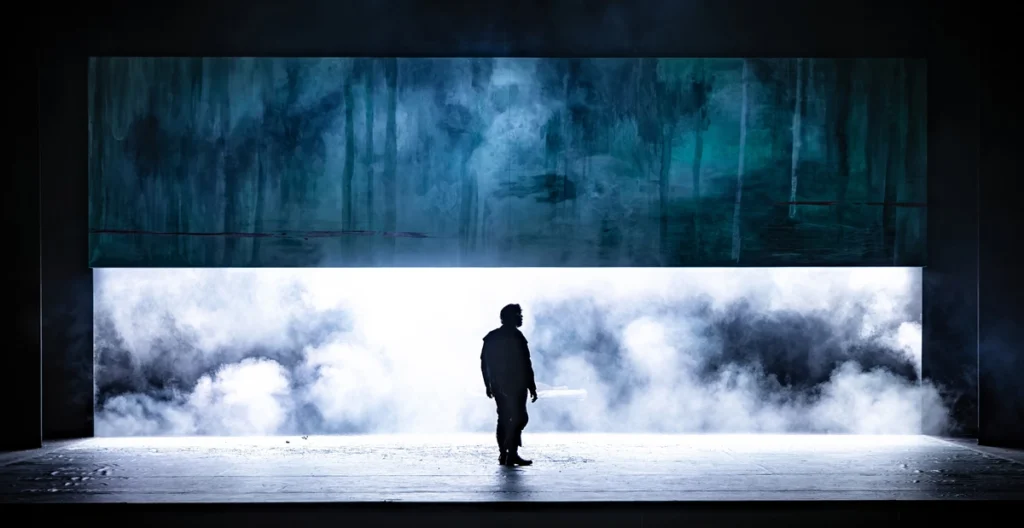
Yet this is not, I would argue, the core aspect of a characterisation of Senta that might make her relatable for a contemporary audience, nor the one her performance, delivered with emotional panache by soprano Rachel Nicholls, leans into the hardest. That we would find in the earlier scene where Senta, enthralled as she looks at the picture of the Dutchman on the wall, retells the story of his curse for the benefit of both her friends and the audience. That is where the character becomes truly relatable – because who has not been a teenager in love with a story? Senta as a religiously motivated martyr may not land for a contemporary audience, but Senta as a teenage girl sighing in front of a poster of a brooding fictional figure, dreaming of him coming to life and coming to her, most certainly does. Having been, once upon a time, a teenage goth myself, I can vouch that had the handsome-yet-damned main character of a favourite book shown up on my doorstep asking that I prove instrumental to his redemption, I would probably not have acted much differently. It is likely not the angle Wagner would have wanted, but it is the one that truly makes it work. Simon Bailey’s Dutchman makes it work, too; he is pacing, he is brooding, he is standing over a sea of mist, he is a tormented hero straight out of a Romantic novel. His vocal performance is well-rounded and emotional, a good conduit for a character who is torn between achieving his own salvation and feeling guilty for the cost this would exact from the innocent young woman who loves him.
Supporting performances were well thought-through and neatly delivered, also; especially worthy of mention are James Creswell’s Daland, choosing a somewhat tongue-in-cheek’s approach to his representation of the captain’s greed; and Leonardo Caimi’s Erik, lending relatability to a character who is inevitably hard to relate to, by means of his frustration and helplessness in the face of a situation he only partially understands. The WNO chorus, as always, is a true asset: Wagner loves a powerful choral section and this production delivers thoroughly on that respect, hitting the mood between the familiarity of the shanty and the ominous creep of the shadow of death as we glimpse the Dutchman’s crew through the mist that fills the stage.
This was also the last performance with the WNO for conductor and music director Tomáš Hanus, who came to the stage upon curtain call to deliver some heartfelt words about his time with the company. He will certainly be missed; through the years his fingerprints have been visible on a number of bold production choices, and he has contributed in making the WNO stand out as one of the most interesting purveyors of opera in the UK. There is no doubt that his shoes will be very hard to fill.
There is one performance in Birmingham, Milton Keynes, and Plymouth
