★★★★★
Il ritorno d’Ulisse is probably the hardest of Monteverdi’s surviving works to bring off on a contemporary stage. First heard during Venice’s 1639–40 carnival season, Ulisse is now called part of a trilogy of Monteverdi works, although that is only a modern term for what has survived. Ulisse, and Orefo which has already been wonderfully staged by Garsington, will be followed by the third work, L’incoronazione di Poppea at Garsington in 2028.
Unlike the great chorus highlights and famous arias that make the other Monteverdi operas particularly popular, much of Ulisse‘s drama is internal, Penelope’s unbroken fidelity, Ulisse’s disorientation on returning to a home he barely recognises, and its music, often recitative and arioso, asks an audience to listen closely rather than just be swept along.
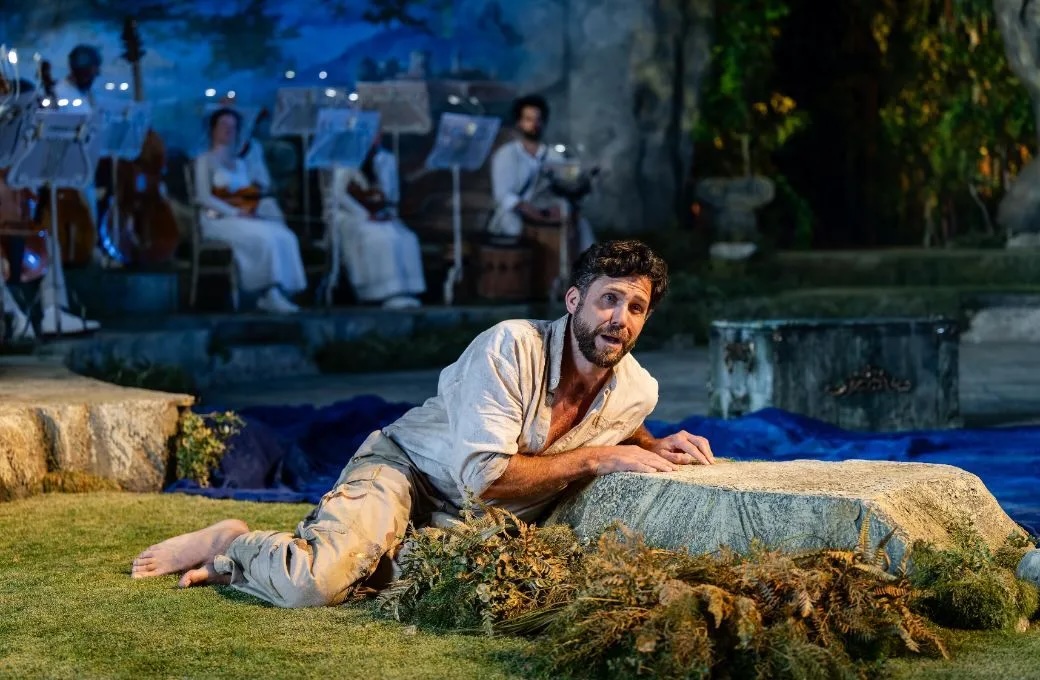
It is all the more impressive that this production works exceedingly well as a drama. That is down to Garsington reuniting the team behind its admired 2022 Orfeo. That continuity is the production’s first idea. John Caird’s direction and Robert Jones’s designs return us to the same half-imagined Renaissance meets Baroque world, the action taking place at the centre of the stage, with musicians set to each side as if on Arcadian slopes around the imagined sea. It is all elegantly lit by Paul Pyant including a ring of light that changes colours depending on the scene. For anyone who saw the Orfeo, this feels less like a new production than a continuation of the old one, cohesive or cautious depending on your taste, but never less than well made. The shared world reached into the audience too: a fair number had turned up, exactly as they did for the Orfeo, in linens that matched the musicians and players, entering into the spirit of the thing with real commitment.
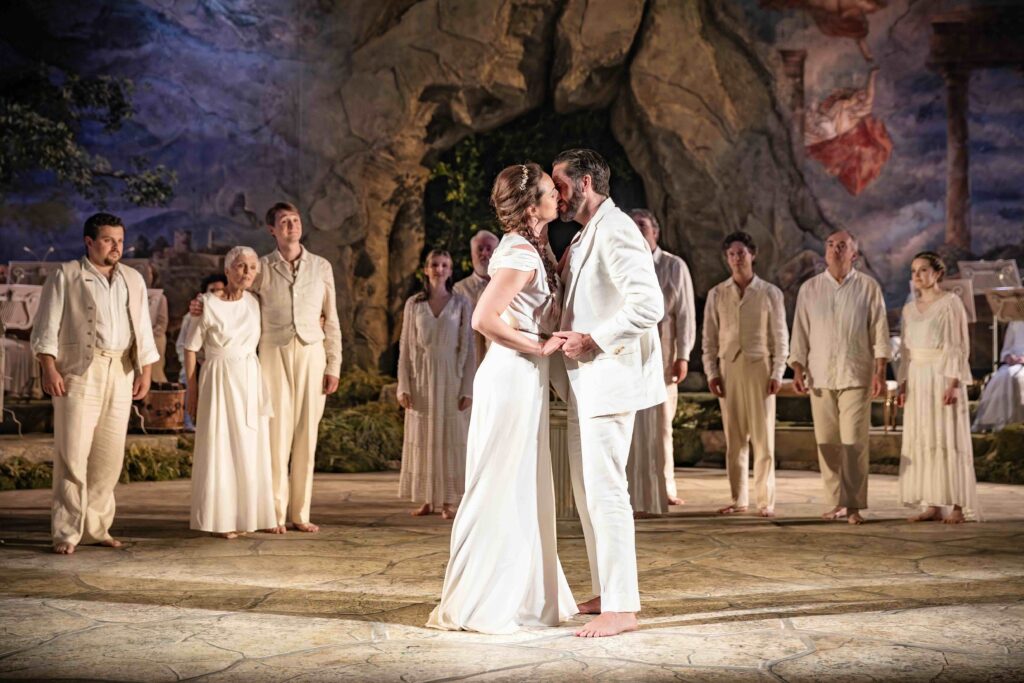
Cecelia Hall and Ed Lyon
The simplest of the staging’s ideas is also one of the best: a long train of blue fabric that Penelope trails onto the set becomes the sea that has kept her husband from her. Clever costuming does plenty of other work too, turning apparently human figures into gods, golden eagles that swoop into the action, and even sheep that wander the stage.
The first half is, it must be said, long. Monteverdi’s exposition is very patient, and the stretch of recitative that establishes Penelope’s isolation and Ulisse’s shipwreck demands real concentration before the interval lets up. But, as with the Orfeo, the patience pays off. Once the situation is set, the drama gathers force: the trial of the bow lands with genuine tension, the killing of the suitors brings a sudden jolt of violence, and the long-delayed reunion arrives with an emotional directness the first half deliberately holds back.
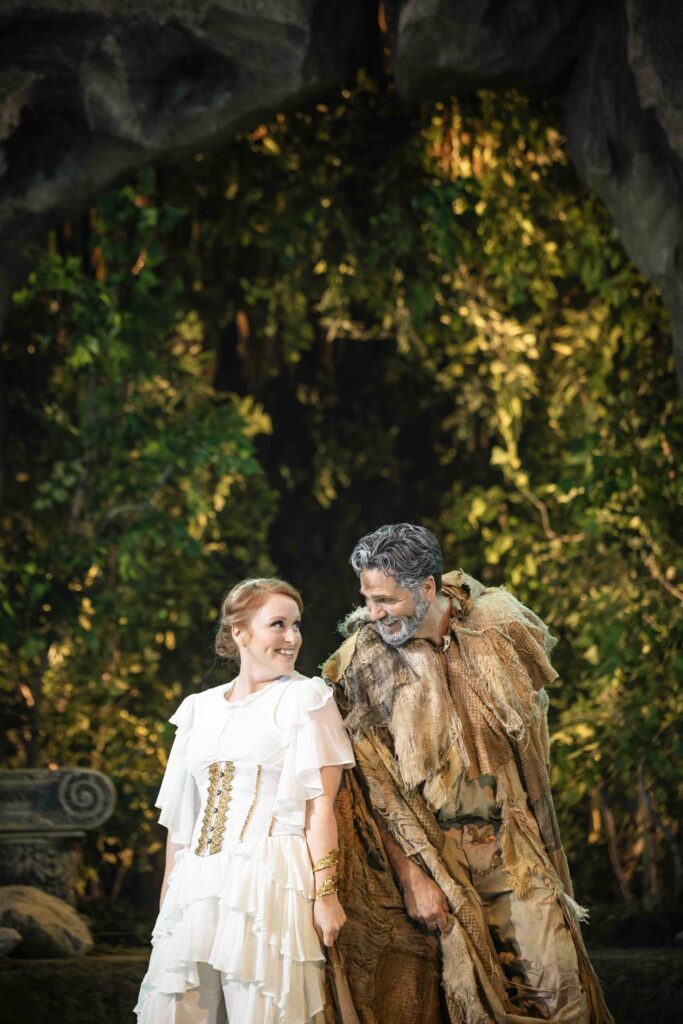
Claire Lees and Ed Lyon
The singing is uniformly fine, as we’ve come to expect at Garsington. Ed Lyon, who sang this team’s Orfeo four years ago, is an Ulisse of quiet authority, moving convincingly between the stoop of the disguised beggar and the bearing of a king reclaiming his throne, and shaping the long lines with an inward, unshowy intensity. He also met an unscripted hazard with great composure on his barefoot first entrance, when the earth literally moved for him and the ground gave way underfoot. He recovered so smoothly that it had no effect on the performance, while the front row gamely leaned in to put the dislodged rocks back on the stage.
Cecelia Hall’s Penelope holds the centre through stillness rather than volume, and she is dramatically very convincing, her long fidelity entirely believable. There is strong work around them: James Gilchrist’s dignified, deeply human Eumete, Claire Lees’s vivid, sharp-edged and cheeky Minerva, Dafydd Jones’s clearly drawn strong Telemaco, and a well-sung company of gods and suitors sung by Alberto Miguélez Roucoin, Benjamin Hulett and James Creswell who each take several roles. James Cresswell is particularly impressive in his other main role as Nettuno. Stuart Jackson’s Iro is a particular pleasure; his extended solo scene, a self-pitying lament at the end of his gluttonous freeloading that ends in his own death, is among the most entertaining things in the evening.
Musically there is little to fault. The English Concert, with Laurence Cummings directing from the keyboard and the players spread across the stage rather than tucked into a pit, are participants as much as accompanists, their sound woven into every scene, while Arielle Smith’s choreography draws soloists and ensemble together easily. That involvement occasionally tipped into mild on-stage mischief, with the “human sheep” of the pastoral scenes now and then needing to be shooed out from among the instruments by the players themselves, the kind of thing no recording will ever capture. The setting did much of the pastoral work by itself: through the glass walls of the pavilion the gardens and parkland lay open behind the stage all evening, and on the slopes beyond grazed real sheep, along with a herd of deer that Homer, for all his thoroughness, somehow forgot to station on the shores of Ithaca. The masterstroke, though, is saved for last. Reminding us of Orfeo, the company peel the instruments away altogether and leave us with a single Monteverdi madrigal, sung unaccompanied, Che dar più vi poss’io, and in that sudden country-house hush the whole evening seems to hold its breath. Pure magic.
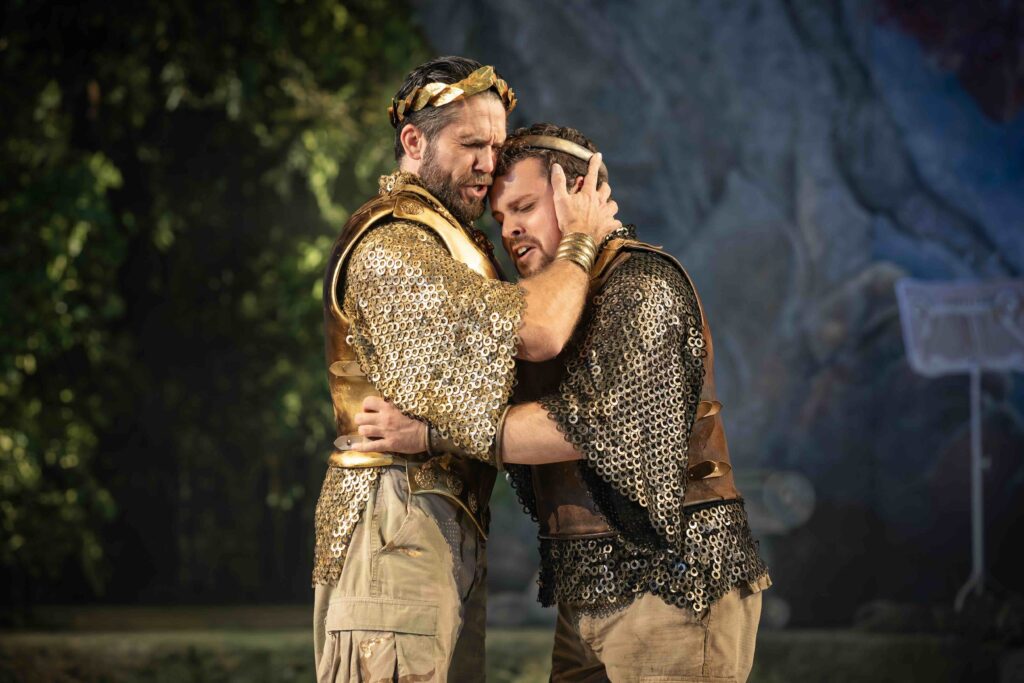
Ed Lyon and Dafydd Jones
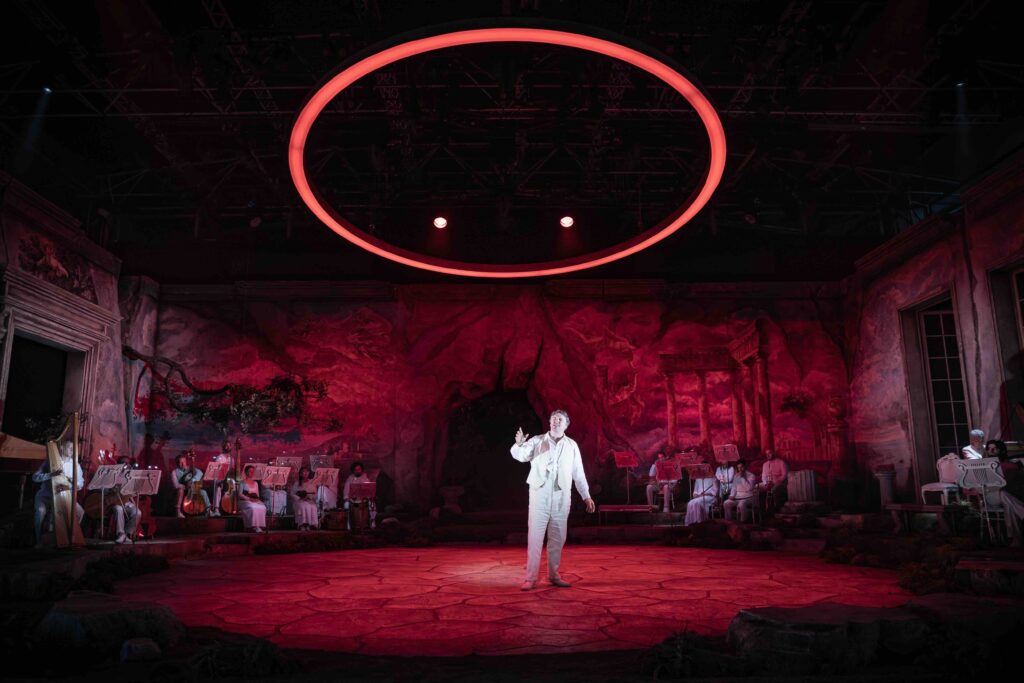
Stuart Jackson
A centuries-old opera staged with this much intelligence and care shows how much can still be drawn from the earliest part of the repertoire when it’s taken seriously. Garsington’s Ulisse is a worthy successor to its Orfeo and we can wait with bated breath for the conclusion of the trilogy.
On this evidence the festival need give no ground to England’s other country-house opera houses; it can match, and beat, the best of them.
Il ritorno d’Ulisse, Garsington Opera at Wormsley, runs until 25 July.
https://garsingtonopera.org/whats-on/il-ritorno-dulisse
Images by Craig Fuller
