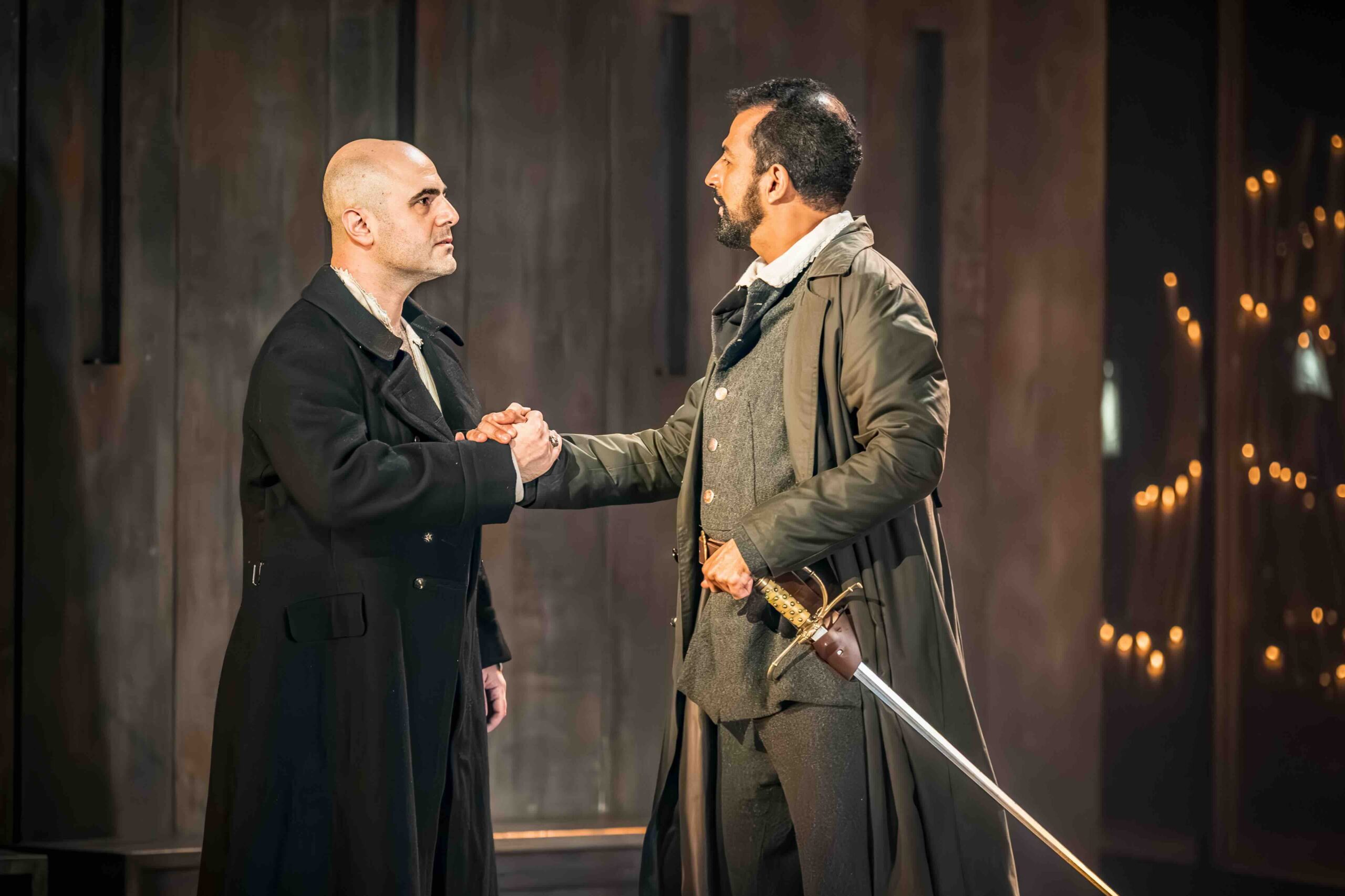
****
Verdi’s Don Carlo remains one of opera’s most compelling examinations of power, politics and human frailty. Packed with forbidden love, friendship, betrayal, religious fanaticism and political manoeuvring, it is also one of the composer’s most demanding works, requiring six principal singers capable of sustaining a drama that unfolds over four acts of intense musical and emotional conflict.
Grange Park Opera’s revival of Jo Davies’ production succeeds because it trusts Verdi’s characters and Verdi’s music. Rather than attempting to recreate the vast scale associated with the world’s largest opera houses, it focuses on the people trapped within this dark story and the consequences of the choices they make.
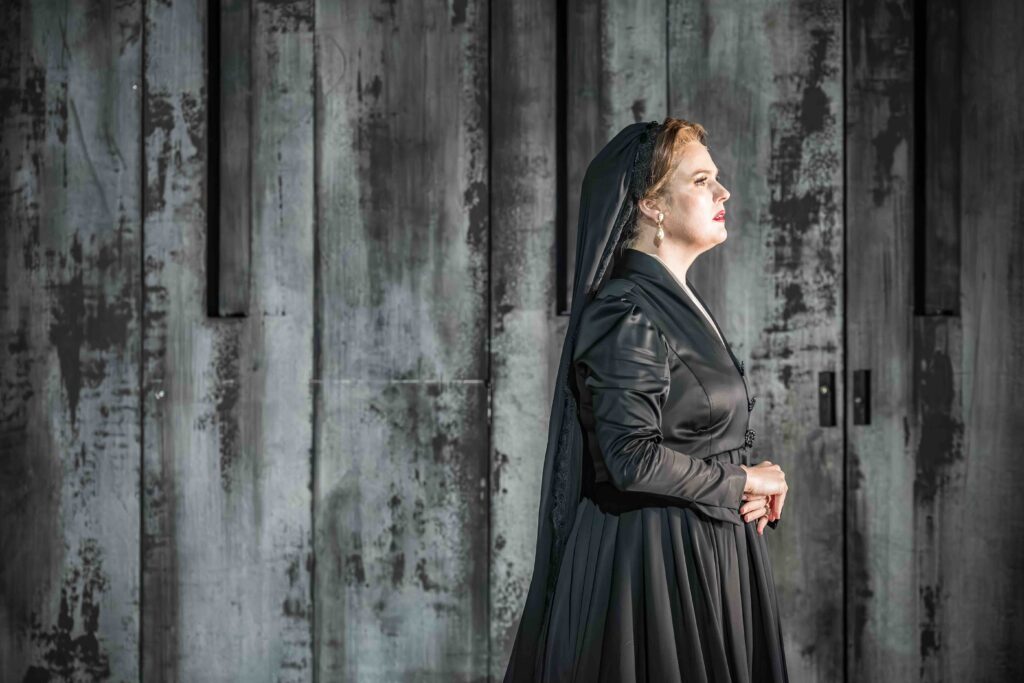
Elin Pritchard
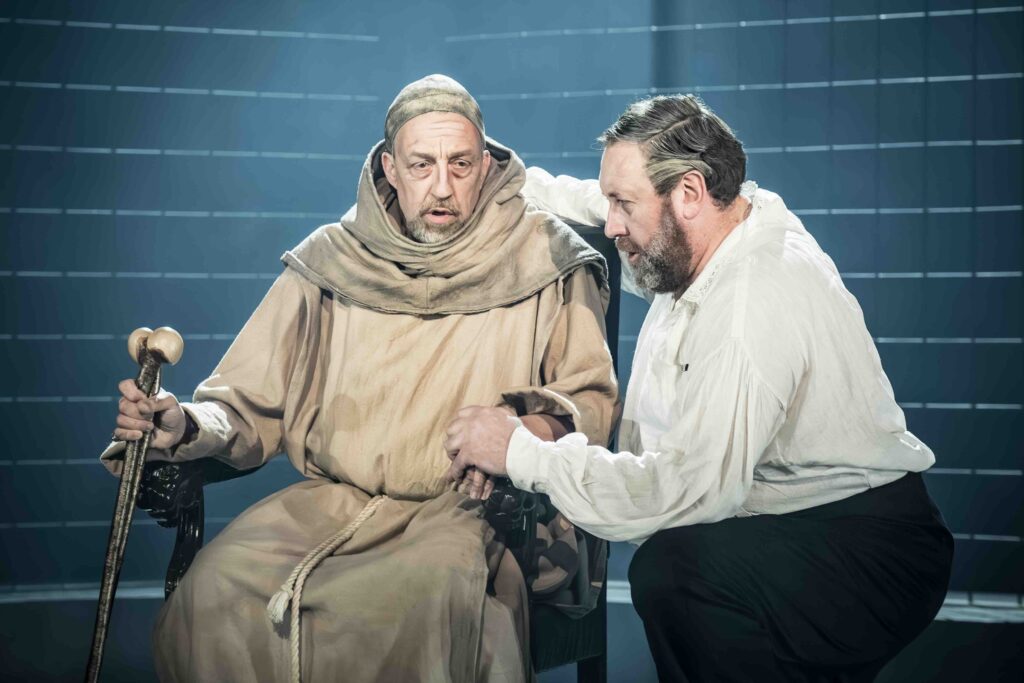
Julian Close and Matthew Rose
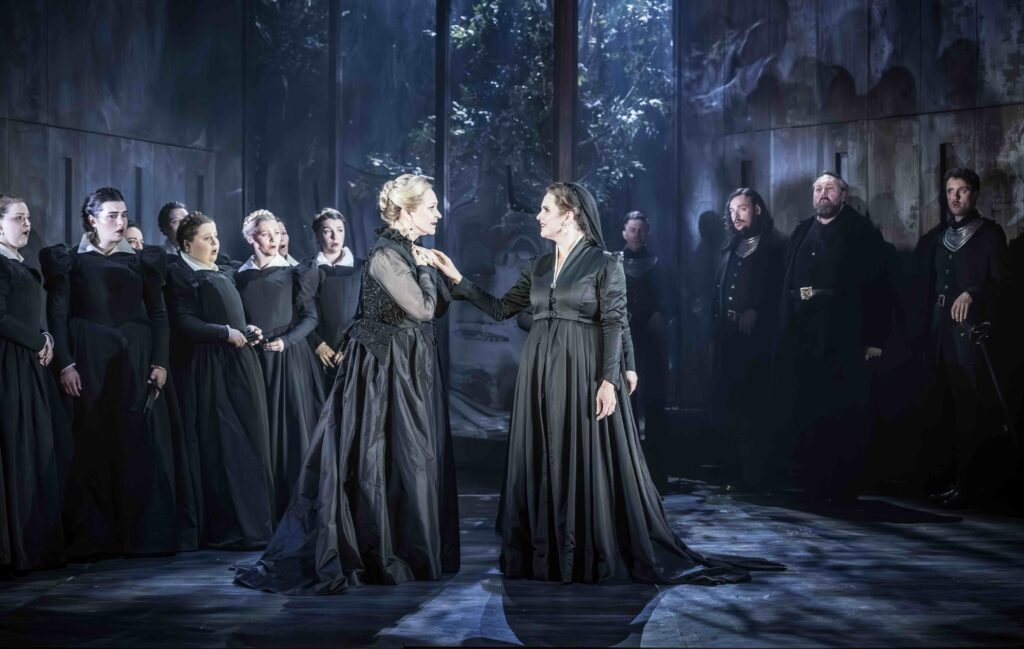
Ruxandra Donose and Elin Pritchard
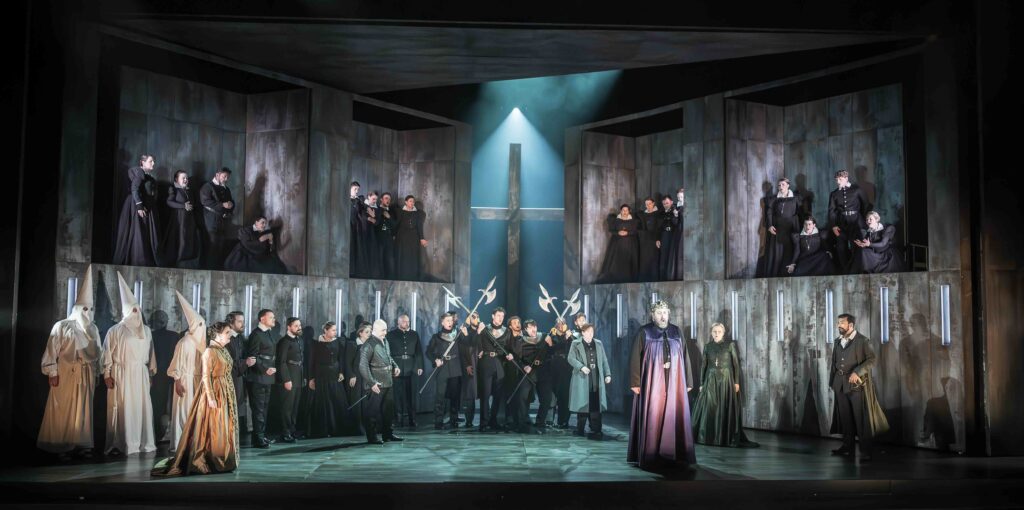
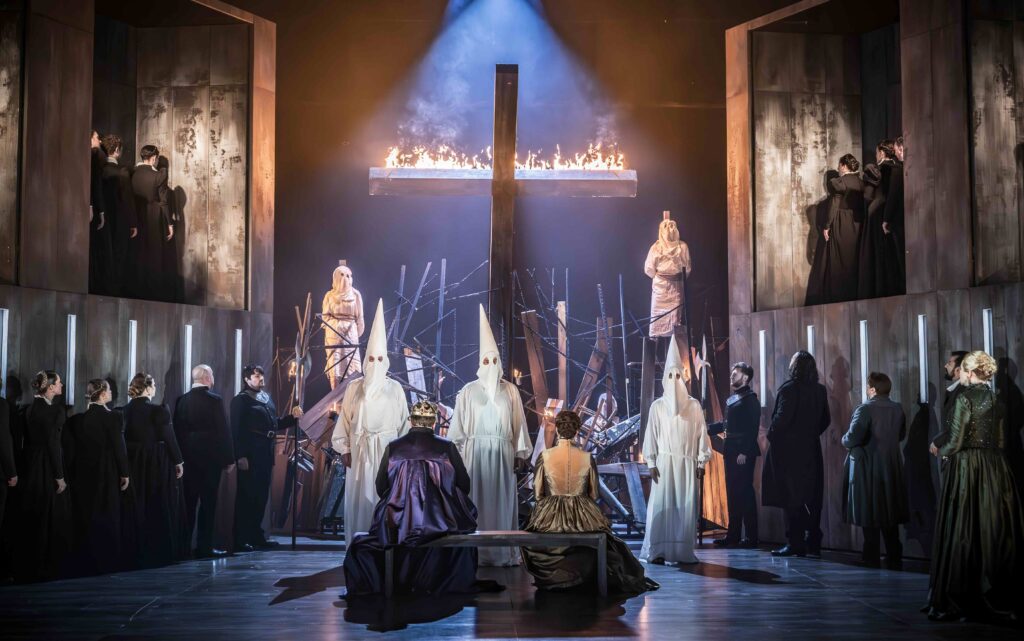
Leslie Travers’ set creates a bleak, enclosed world of dark timber walls, hidden entrances and narrowing perspectives. Characters appear almost imprisoned within it. Anna Watson’s atmospheric lighting makes excellent use of darkness, candlelight and shadow, reinforcing the sense that nobody can escape either political power or personal destiny. The visual simplicity proves highly effective and, aided by Davies’ tight dramatic direction, overcomes any need for massive scenery or huge crowd scenes.
The production is not without flaws. Some scene changes feel unnecessarily prolonged and occasionally interrupt the dramatic momentum that Verdi works so hard to establish. More significantly, the ending introduces an explicit act of violence which I found entirely unnecessary. Don Carlo already possesses one of opera’s most ambiguous and haunting conclusions. This additional intervention felt gratuitous, reducing rather than enhancing the mystery and emotional impact of the final moments.
Fortunately, the musical standards are sufficiently high that such reservations become relatively minor.
Among the male principals, Michel de Souza’s Rodrigo was particularly impressive. Warmly sung and deeply felt, his performance captured both the nobility and humanity of the Marquis of Posa. De Souza’s attractive baritone combined elegance with conviction, making Rodrigo the moral centre of the drama. His friendship with Carlo felt entirely believable, and his final scenes carried genuine emotional weight. The great friendship duet Dio, che nell’alma infondere emerged as one of the evening’s musical highlights.
Matthew Rose brought considerable authority to Philip II. Rather than portraying him simply as a tyrant, Rose revealed the loneliness and vulnerability that lie beneath the king’s immense power. His great aria Ella giammai m’amò was moving and beautifully controlled, presenting a man who can command an empire but cannot secure affection from those closest to him. Rose’s rich bass and commanding stage presence made every appearance count.
Julian Close made an equally powerful impression as the Grand Inquisitor. Frail in appearance but terrifying in influence, his portrayal brilliantly captured the character’s ability to dominate everyone around him. Close’s dark bass cut through the theatre with chilling authority, particularly in his confrontation with Philip, where it becomes abundantly clear who truly holds power in this society. Despite the character’s blindness and apparent physical weakness, Close created an unforgettable embodiment of religious absolutism and institutional menace.
Otar Jorjikia faced the challenge of making Carlo sympathetic despite the character’s frequent indecision and emotional volatility. His tenor brought considerable strength to the role, particularly in the opera’s larger dramatic moments. At times one wished for greater variation of colour and dynamics in the more introspective passages, but his commitment never faltered and his scenes with de Souza provided some of the evening’s strongest dramatic moments.
Among the women, Elin Pritchard brought warmth, dignity and vocal distinction to Elisabetta. Her singing combined elegance with emotional depth, and she crowned the evening with a beautifully shaped account of Tu che le vanità. The voice remains consistently attractive throughout its range, and her portrayal balanced regal authority with touching vulnerability.
Ruxandra Donose delivered a powerful Eboli, bringing dramatic intensity and vocal security to one of Verdi’s most demanding mezzo-soprano roles. Her O don fatale was one of the standout moments of the evening, sung with thrilling commitment and emotional force.
Harrison Chéné Gration contributed a suitably mysterious Monk, while Rosa Sparks made a striking impact as the Voice from Heaven, her radiant soprano soaring effortlessly above the auto-da-fé scene.
In the pit, Gianluca Marcianò drew committed and stylish playing from the Orchestra of English National Opera. While reduced orchestral forces inevitably alter some of the grandeur Verdi originally envisaged, Marcianò ensured that the score’s dark colours and dramatic urgency remained fully intact. The Grange Park Chorus produced a thrilling weight of sound whenever called upon.
What ultimately makes this Don Carlo so successful is its concentration on character rather than spectacle. The production’s dark visual world, careful direction and atmospheric lighting create a powerful framework, but it is the strength of the singing that lingers longest in the memory. Verdi’s great drama lives or dies on the quality of its principals, and Grange Park has assembled a cast capable of doing full justice to one of opera’s most demanding masterpieces.
Despite reservations about the ending, this was a compelling, musically distinguished evening, dominated by strong performances across the cast and a profound understanding of the human tragedy that lies at the heart of Verdi’s score.
Main image: Otar Jorjikia and Michel de Souza
Images by Marc Brenner
grangeparkopera.co.uk
