
***
There is only one real test of a successful performance of Puccini’s Madama Butterfly. That is whether you leave with a tear in your eye as no matter how much a director may wish to play with you intellectually, this is a work that must succeed emotionally.
Yes, for some it is a difficult opera to accept with contemporary causes célèbres, and all manner of theatrical jiggery-pokery is employed to sate certain hashtags. However, the opera speaks (or sings) for itself. Imperialism? Bad. Abuse of women. Bad. Cultural stereotyping. Bad. Singers of one ethnicity singing roles representing others? Let’s not go there.
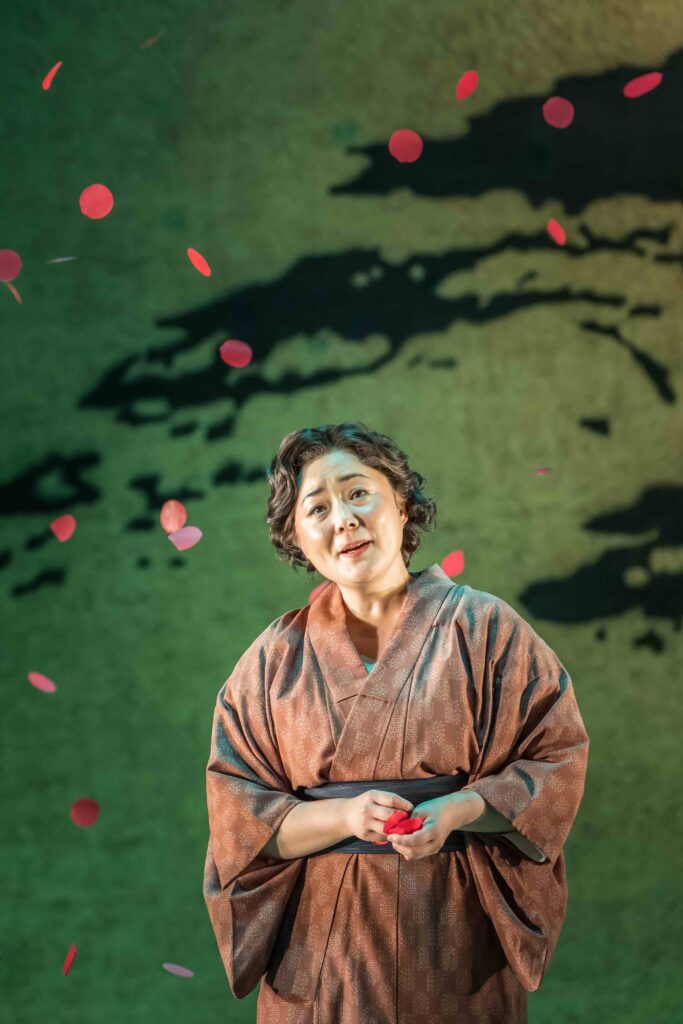
Hye-Youn Lee
John Doyle’s latest take on Madama Butterfly is a study in minimalism – visually and dramatically. The space is s series of gold frames one within the other, a stylised Japanese tree on a gold backdrop and a bare stage with only three red Japanese-style chests. Walls and doors are replaced with three simple bamboo roller blinds, and only Madama Butterfly/Cio-Cio-San in a colourful traditional costume. The Americans dress in what seems 1950s clothes for some reason, the Japanese wear drab presumably authentic costumes, with the marriage broker sporting elements of Western and Japanese garb (a well-used trope).
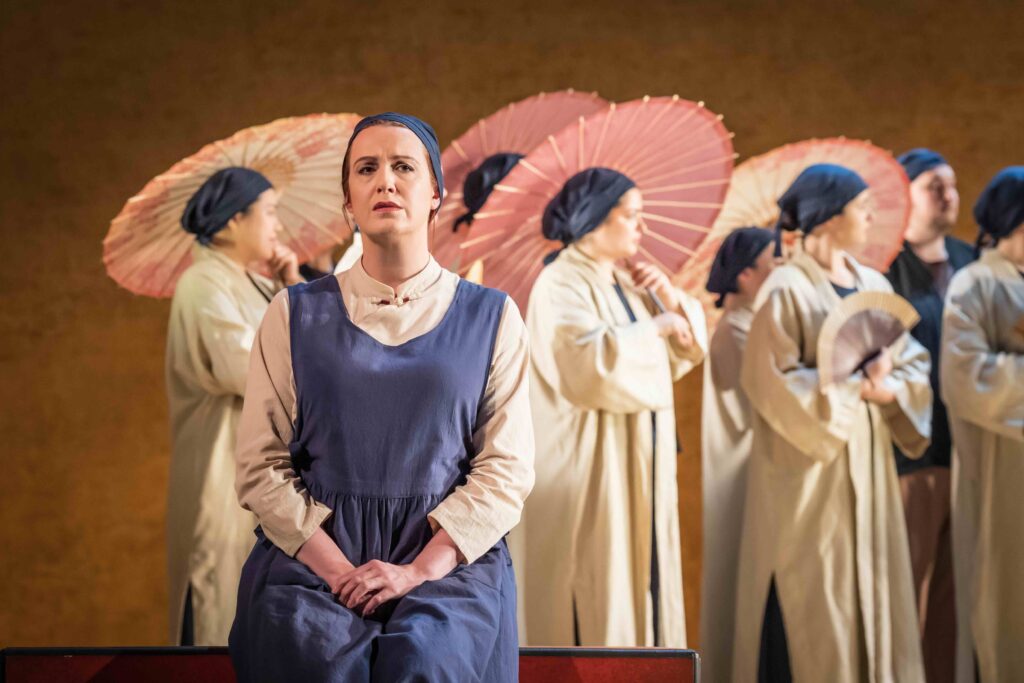
Kitty Whately
While this barebones approach generally allows Puccini’s narrative to unfold clearly, it also creates some awkwardness. Characters disappear behind a lowered bamboo roller blinds and then emerge a few seconds or minutes later. Sharpless has to knock on one of the three chests as there is no door.
All this aside, at the heart of the evening, however, is an absorbing performance from South Korean soprano Hye-Youn Lee, whose Cio-Cio-San commands attention and was given a rapturous standing ovation. She is neither a stranger to the role nor singing it at Grange Park Opera. Of course, we suspend disbelief that she is a 15-year-old girl, so we can enjoy Lee’s interpretation that is full-blooded, anguished, and vocally radiant. Her gestures, movements, reactions are genuine and convincing. The passion of her first love, her shame at her father’s death, and then horror of being rejected by her own people for changing her religion, and the harrowing delusion of Pinkerton’s “real marriage” are all utterly heartbreaking. Her “Un bel dì” is sung with aching belief and desperate hope. In fact, I don’t really want to see anyone else doing Butterfly for a while. For example the letter scene with Sharpless, she reacts to each line with total conviction and traces the arc of her emotions with absolute clarity and conviction, from anticipation, through happiest woman in Japan to fury when she confronts Sharpless with Sorrow.
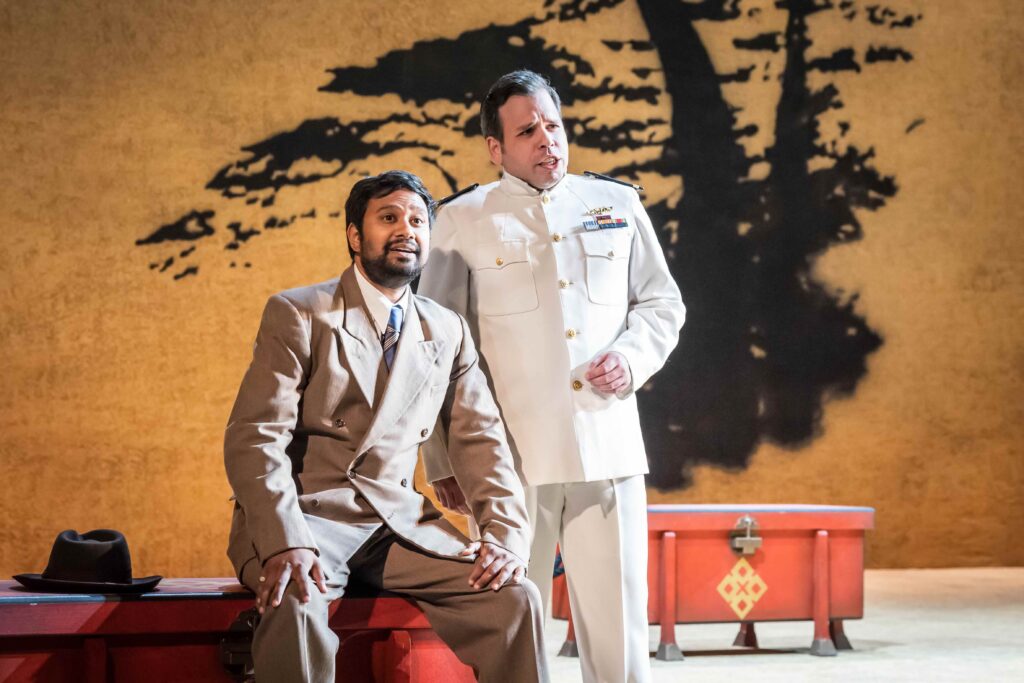
Ross Ramgobin and Luis Gomes
The rest of the cast provide solid support. Clearly regarded by the director as pivotal, mezzo Kitty Whately gives a tender, quietly intense Suzuki, knowing from the outset where this will end. (The fact that the knife sent to Madama Butterfly’s father by the Mikado is always in sight does not augur well!). This also seems to be the role of Ross Ramgobin’s sympathetically drawn Sharpless, his gentle baritone matched with charming acting. However, like the powerfully sung Pinkerton of tenor Luis Gomes, (despite some straining at times), these are roles that are pretty thankless. Yes, the staging softens Pinkerton’s culpability, painting him as weak rather than cruel, but even the tenor accepts this is unconvincing, pantomime-style pretending to hang himself with his tie at the curtain call.
The Gascoigne Orchestra, under Stephen Barlow, plays carefully and is kind to the singers, but it is the power of the voice that carries the evening –with Hye-Youn Lee at the centre.
Until July 5.
https://grangeparkopera.co.uk/whats-on/madama-butterfly
Also at Grange Park 2025:
Read more: Madama Butterfly, Grange Opera
One thought on “Madama Butterfly, Grange Opera”