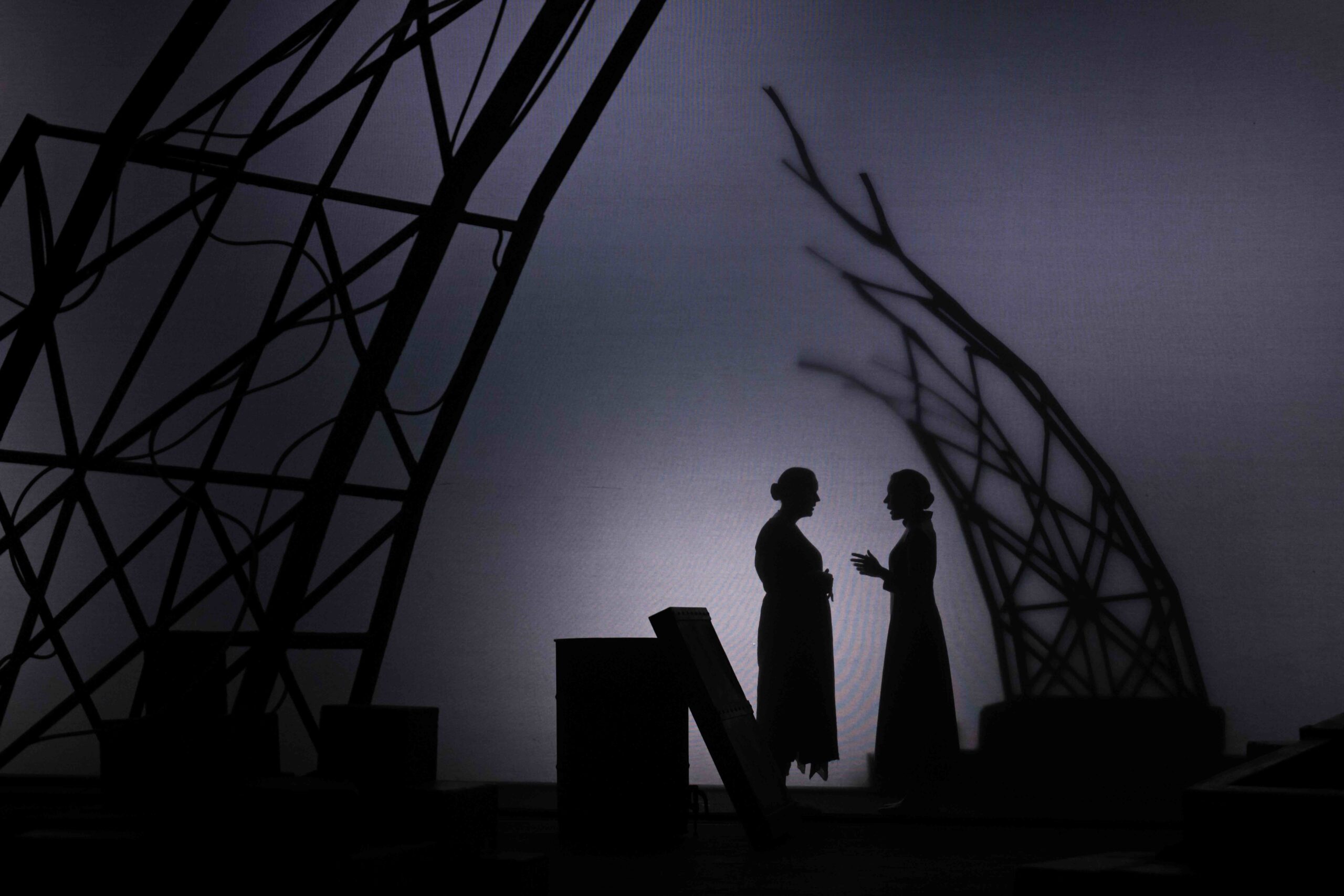
Karolina Sofulak’s new production of Macbeth is one of those evenings that leaves you admiring the thinking behind it more than the theatrical experience itself. There is no shortage of ideas.
Designer Kimie Nakano’s landscape of twisted steel, dominated by what resembles the skeletal remains of a collapsed electricity pylon, immediately evokes a kingdom poisoned from within, its political and moral order reduced to rust. It is an arresting image and one entirely capable of serving Verdi’s darkest tragedy.
The difficulty is not that Shakespeare has been modernised or that medieval Scotland has disappeared. Opera has repeatedly proved that contemporary settings can illuminate familiar works. The problem is that this production frequently assumes knowledge that it should itself be supplying.
That matters because Verdi’s Macbeth is not Shakespeare’s play. Shakespeare has five acts in which to establish relationships, political loyalties and geography. Verdi has little more than two and a half hours. His opera moves with relentless dramatic momentum, demanding immediate theatrical clarity if the audience is to remain emotionally engaged. Here, symbolism too often replaces storytelling. Characters beyond the principal roles are insufficiently differentiated, the movement between Scotland and England is only loosely defined, and several additional theatrical devices ask the audience to interpret the concept rather than surrender to the drama.
An extended puppet sequence is the clearest example. It neither deepens the psychological conflict nor advances the narrative, instead interrupting the flow at precisely the moment Verdi’s score is driving inexorably forwards. Likewise, the largely uniform costumes worn by much of the supporting cast blur distinctions between the various factions, making an already compressed drama harder rather than easier to follow. Theatre should encourage thought, but it should never require the audience to solve it.
Fortunately, Verdi’s music possesses an expressive force that repeatedly cuts through those uncertainties, and Longborough has assembled a cast capable of matching it.
Viktoriia Balan’s company debut is a triumph. Lady Macbeth is one of Verdi’s most demanding creations, requiring not simply vocal stamina but complete dramatic conviction, and Balan delivers both. The voice combines warmth, richness and thrilling brilliance across its range, but what impresses most is the intelligence behind the singing. Every phrase has dramatic purpose. Rather than presenting Lady Macbeth as a pantomime villainess, she creates a woman driven by absolute certainty, manipulating everyone around her because she never once doubts herself. That certainty makes her eventual collapse all the more compelling. Even if the production never fully finds a convincing theatrical language for the sleepwalking scene, Balan’s performance charts the character’s psychological disintegration with unwavering authority. It is the sort of debut that immediately marks out a singer to watch. It will now be interesting to see how her voice works in a much larger space.
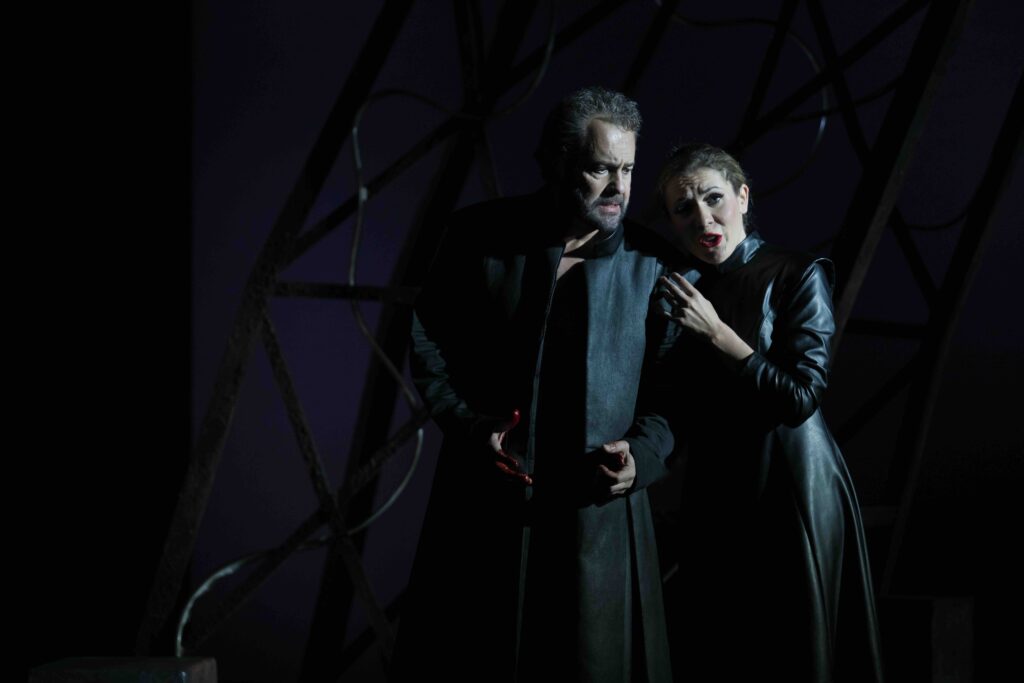
Mark Stone and Viktoriia Balan
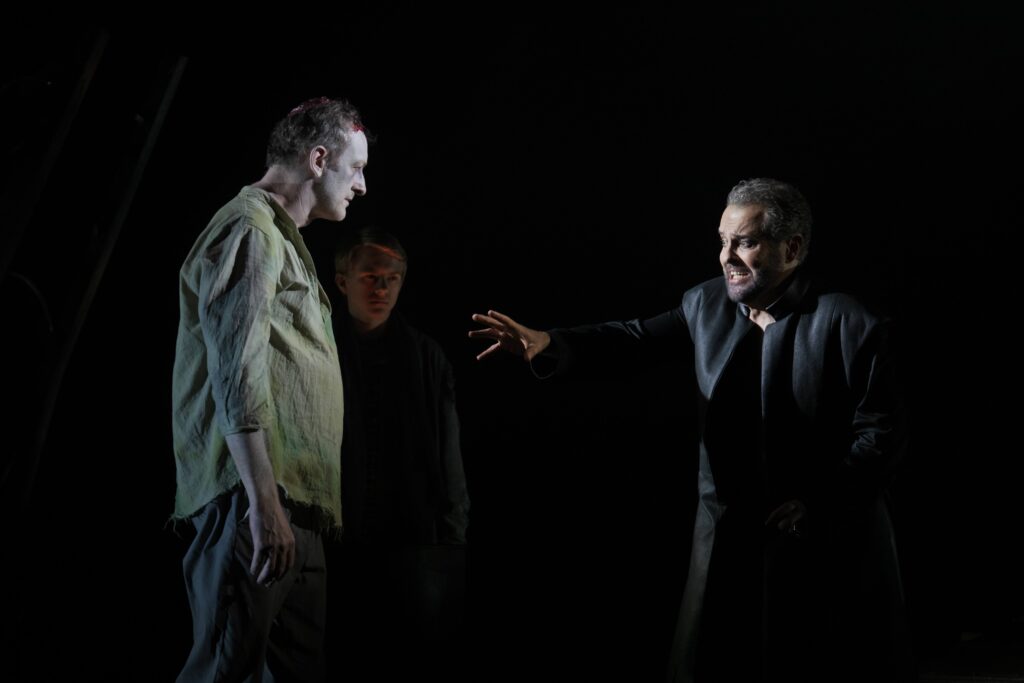
John Molloy and Mark Stone
Mark Stone proves an ideal dramatic partner. Instead of portraying Macbeth as a man consumed by naked ambition from the outset, he traces the gradual destruction of an honourable soldier whose moral certainty is steadily dismantled by prophecy, persuasion and guilt. His expressive baritone conveys authority without bombast, while his thoughtful characterisation makes the tragedy profoundly human. By the final act, Macbeth is less a tyrant than a man trapped by the consequences of his own weakness. If the relationship between husband and wife never quite generates the dangerous erotic electricity that lies beneath Verdi’s score, responsibility rests less with the singers than with a production whose emotional temperature remains unexpectedly restrained.
John Molloy lends Banquo quiet nobility and understated authority, providing an effective moral counterweight to Macbeth’s disintegration. Rhydian Jenkins sings Malcolm with confidence and clarity, while Bernadette Johns makes an eloquent contribution as the Lady-in-Waiting, her brief appearance leaving a stronger impression than its length might suggest. It is this attention to even the smaller roles that continues to distinguish Longborough from many larger companies.
Longborough’s remarkable consistency in casting is once again evident throughout the supporting roles. The warmest ovation of the evening quite rightly greeted Jung Soo Yun’s Macduff. Trained by the distinguished Welsh tenor Dennis O’Neill, Yun brought beautifully focused tone and unaffected sincerity to “Ah, la paterna mano”, his lament for his murdered family becoming one of the emotional high points of the performance. There was nothing self-indulgent about the singing; instead it communicated grief with directness and dignity, leaving one wishing Verdi had given Macduff rather more to do.
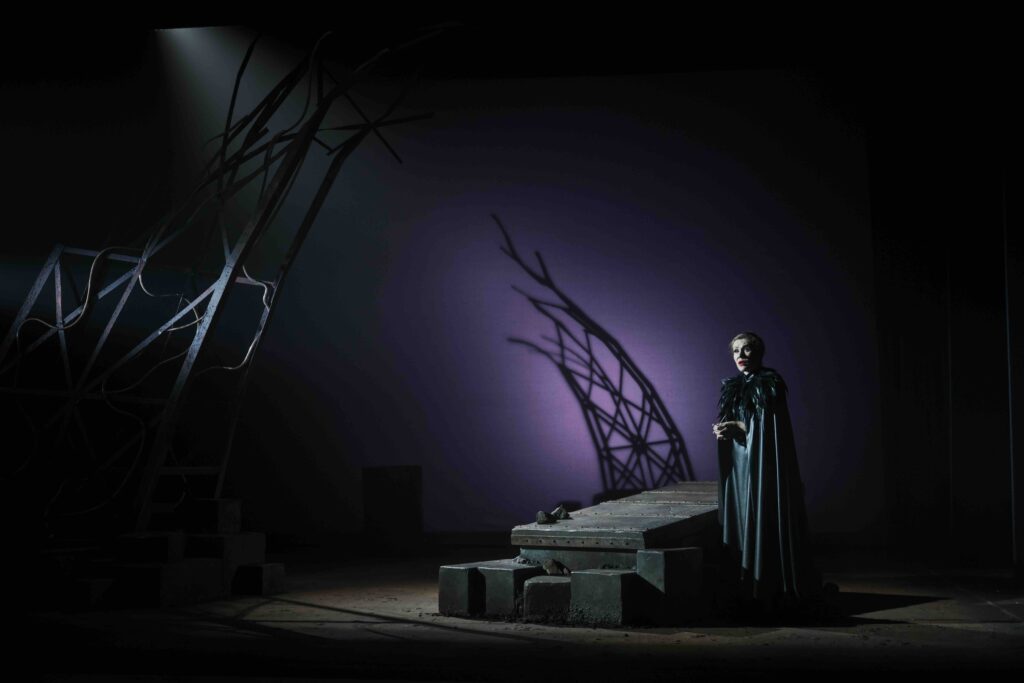
Viktoriia Balan
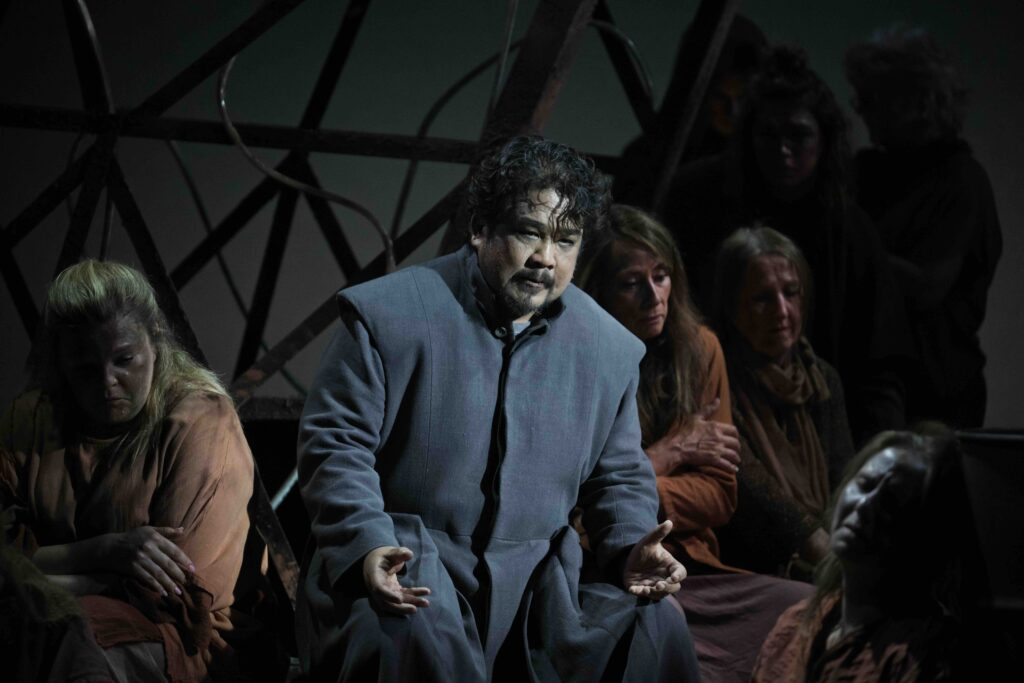
Jung Soo Yun
The chorus encapsulates both the strengths and weaknesses of the evening. Musically they are magnificent, producing thrilling weight, precision and commitment throughout Verdi’s demanding score. Dramatically, however, they remain curiously elusive. At different moments they appear to function as witches, courtiers, soldiers, refugees and anonymous witnesses, yet the production provides few theatrical clues to explain these shifting identities. As the action moves between Scotland and England and back again, the visual storytelling never entirely keeps pace with the music. The result is less intriguing ambiguity than unnecessary uncertainty.
If the stage occasionally loses dramatic focus, Nil Venditti never allows the score to do so. From the ominous opening bars onwards she drives the Longborough Festival Orchestra with urgency and purpose, allowing Verdi’s orchestration to generate the menace, tension and psychological unease that the production itself sometimes struggles to sustain. Time and again it is the orchestra that restores dramatic momentum, reminding us that Macbeth remains one of Verdi’s most compelling studies of power, fear and moral collapse.
There is much to admire in Sofulak’s ambition, even if not every idea reaches full theatrical realisation. This is a production that stimulates the intellect more readily than it engages the emotions, occasionally mistaking opacity for profundity. Yet Verdi’s masterpiece proves magnificently resilient. Supported by an outstanding cast, a superb chorus, and an orchestra playing with exceptional commitment, Longborough once again demonstrates that its greatest strength lies in its musicians. If the eye is sometimes left searching for greater clarity, the ear is rewarded almost without interruption. In the end, it is Verdi’s music, performed here with remarkable conviction, that tells the story with the greatest truth, and that is what lingers longest in the memory.
Until July 16
https://lfo.org.uk/opera/macbeth
Images by Matthew Williams-Ellis
