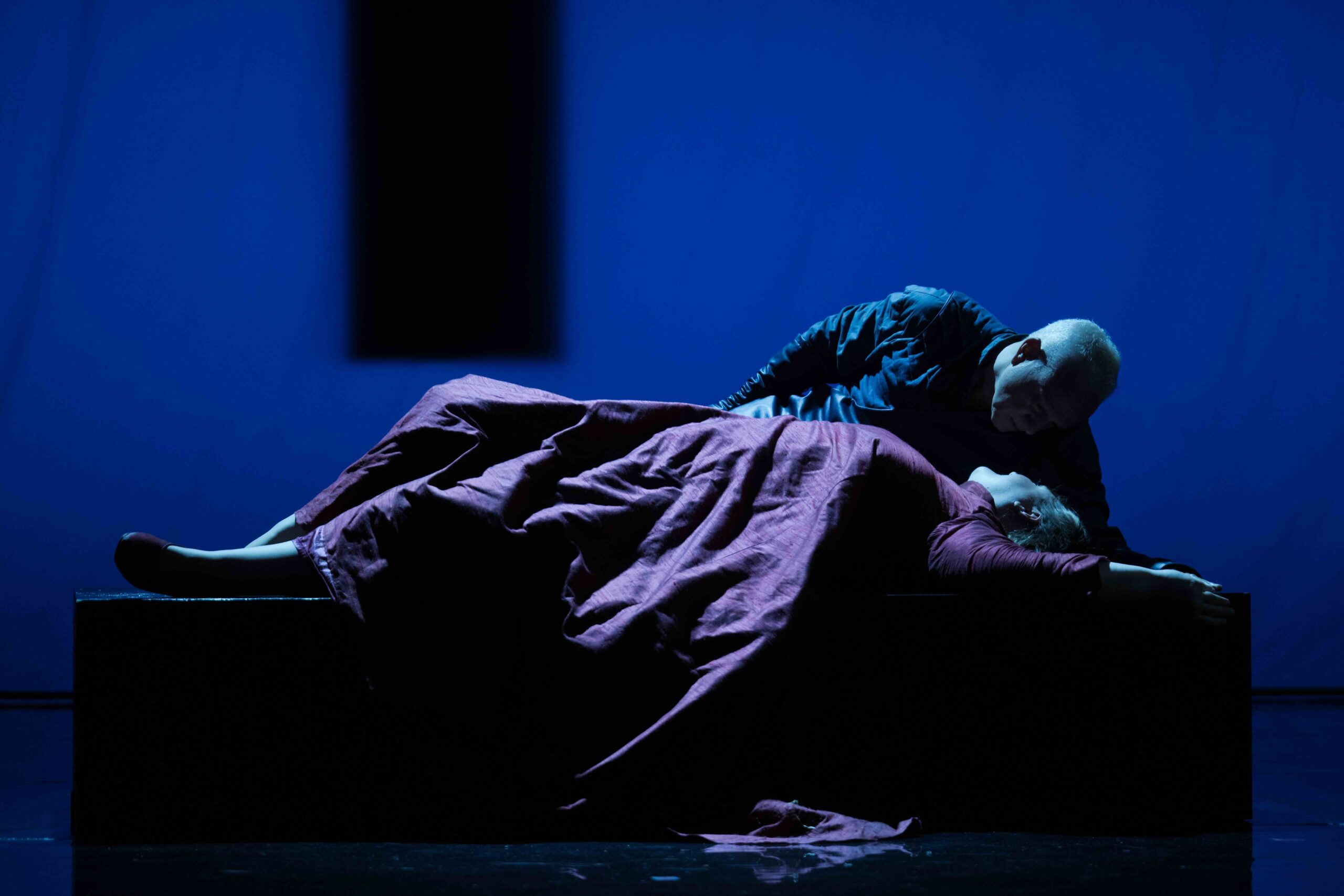
For several seconds after the last chord had faded, nobody moved. No cough, no rustle, no premature clap, just a whole auditorium held, as if exhaling would break something. Only when the spell finally cracked did it give way to an ovation that seemed to come from somewhere deeper than the usual reflex of applause. That silence is the truest review Longborough Festival Opera’s Tristan und Isolde could be given. You do not sit in stunned quiet at the end of an evening that has merely gone well; you sit in it when something has got past your defences.
It helped that the man in the pit had arrived that night already garlanded. Anthony Negus, Longborough’s veteran Wagnerian and the presiding spirit of its music-making, has just been appointed CBE, and the honour felt less like news than overdue confirmation of what anyone who has heard him conduct this score already knew. His Tristan holds Wagner – and us – in a taut, unrelenting place until all is released in the Liebestod. The Longborough Festival Orchestra responded to their conductor with warmth, concentration and remarkable refinement, proving once again that this converted Cotswold barn succeeds in Wagner not despite its intimacy but because of it.
Carmen Jakobi’s staging, revived and already altered in an earlier revival, trusts the music to carry the emotional weight. Similarly, Kimie Nakano’s designs create a pared-back, almost abstract landscape. Of course, this is the world the lovers inhabit – yearning for nighttime when they can be together, and then, as they long for death, a strange demi-monde. This requires any actual ships, castles and gardens of the libretto to be removed and replaced with a psychological drama aesthetic. Therefore rather than follow a narrative, the production explores the weird space inhabited by its characters. In fact it is almost as if they had died when they take the love potion rather than poison.
Peter Wedd’s Tristan has done something rather inconvenient: it has rewritten the role in my head. Returning to a character he has made very much his own at Longborough, Wedd displays complete dramatic conviction. The voice shows power that, like the character, just refuses to die. Yet, impressive though the singing is, it is the acting that lingers longest in the memory. His third act becomes a painfully truthful portrait of a man drifting between lucidity and delirium, clinging to hope while his mind and body gradually betray him. Every movement, every hesitation and every fragment of memory feels psychologically inevitable. I suspect I shall judge future portrayals of Tristan against this one, whether I intend to or not.
Catharine Woodward proves an equally compelling partner as Isolde. Her assumption grows steadily throughout the evening, beginning with proud, almost implacable authority before revealing increasing warmth and vulnerability as the drama unfolds. By the final transfiguration she finds a luminous inwardness that crowns the evening with genuine emotional radiance. She never forces the voice, yet rides Wagner’s great orchestral climaxes with assurance, allowing the music to bloom rather than simply conquering it.
Around them, Longborough demonstrates once again the extraordinary consistency of its casting. Catherine Carby’s Brangäne is far more than a loyal confidante. Her offstage warnings in the second act float across the auditorium with haunting beauty, momentarily suspending time itself. Robert Hayward brings steadfast loyalty and quiet dignity to Kurwenal, while Alastair Miles delivers a King Marke of pathos and humanity. His long monologue shows a man, perhaps rather a weak figure, who cannot comprehend how those he trusted have brought him to this point. Like his hero Tristan, and in fact Isolde too, he literally as well as metaphorically finds himself almost pinned against a wall, unable to grasp what has happened. Brian Smith Walters contributes a sharply characterised baddie Melot, and Peter Bronder’s Shepherd brings unaffected simplicity to one of the opera’s most exquisite moments. There is not a weak link anywhere in the cast.
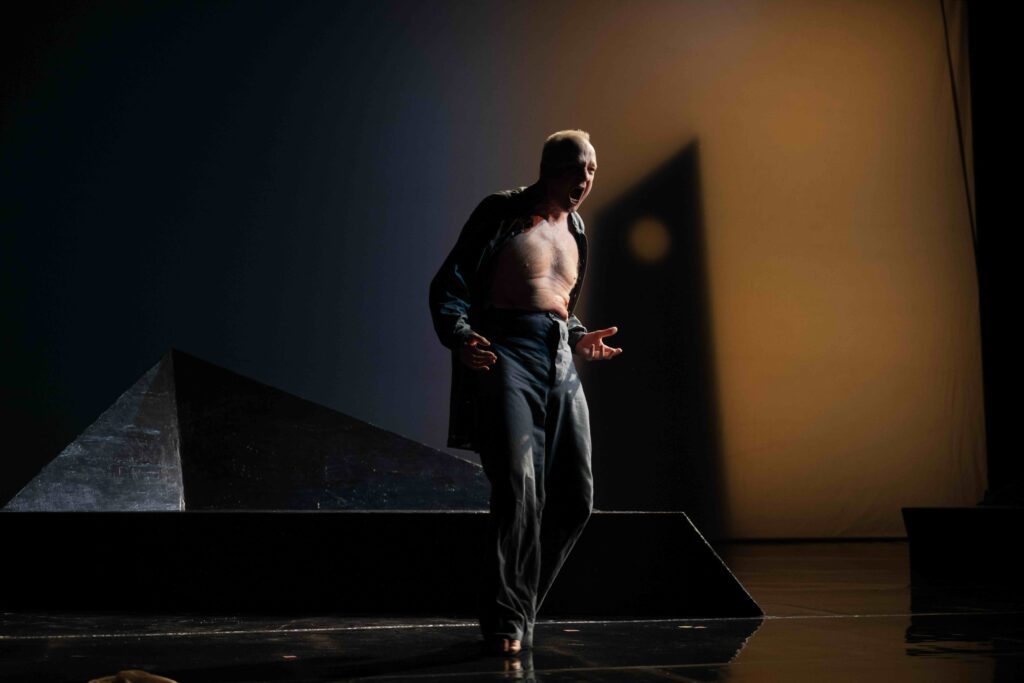
Peter Wedd
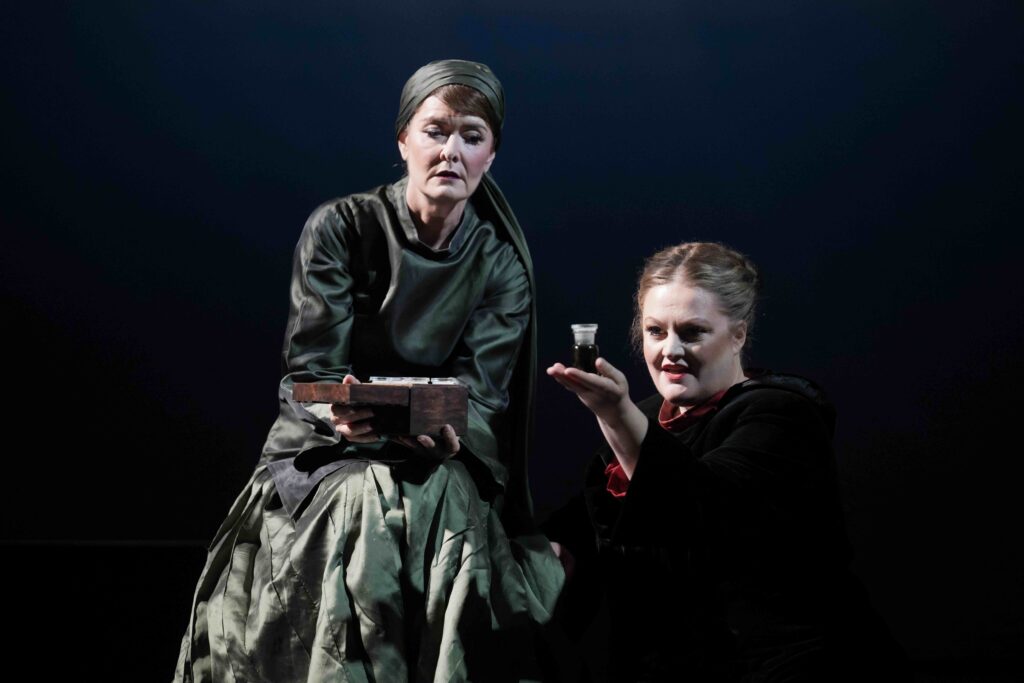
Catherine Carby and Catharine Woodward
Clearly, Longborough attracts audiences for the playing and singing of Wagner first, rather than a great theatrical spectacle, and this Tristan continues to vindicate that philosophy completely. The production illuminates without imposing, the orchestra plays with extraordinary commitment, and Anthony Negus once again demonstrates why he remains one of Britain’s foremost Wagner conductors. It is no surprise that his protégé, Harry Sever, is conducting at Grange Park Opera as it tries its hand at the Ring Cycle.
Above all, the performances of Peter Wedd and Catharine Woodward remind us that the greatest Wagner singing is never merely about endurance or volume (neither of which is lacking), but about revealing the humanity that lies beneath the mythology. To be frank, some of Tristan’s final death throes monologue can be, shall we say, an acquired taste. But with Wedd’s quite chilling acting, it is totally gripping.
The applause, when it finally came, was thunderous and entirely deserved. Yet it is the silence beforehand that I shall remember. In that quite shocking, extraordinary stillness lay the measure of an evening that had reached beyond admiration into something rarer: a performance that left an audience momentarily frozen to their seats.
Until July 18
https://lfo.org.uk/opera/tristan-und-isolde
Images Matthew Williams-Ellis
Main image Peter Wedd and Catherine Woodward
