Grange Park warned us it would be hot. So hot that Das Rheingold, normally played in one unbroken run, would get a fifteen‑minute cooling‑off break. As it turned out, the heat was not a problem.
The only real trouble was seemingly technical. Charlie Edwards’s concept for Grange Park Opera’s new Ring Cycle, judging from the prologue, is wired to a clever idea about electricity, which, for at least the opening scenes, short‑circuited.
Edwards builds his staging on projections thrown onto a gauze at the front of the stage, and on my night that gauze flickered on and off as if with a will of its own. At first I couldn’t be sure it was a fault. The production deliberately tips its hat to the very first Bayreuth Ring of 1876, all machinery and singers hauled about on contraptions, so a bit of dodgy light might have been the point. It wasn’t. When the projections cut out, they left the three Rhinemaidens, Ailish Tynan, Olivia Rose Tringham and Charlotte Bateman, in full view on stepladders. Mistake or history lesson? I genuinely couldn’t say.
Then as a world swelled into a giant glowing sphere the projections continued to go on and off at a shocking (no pun intended) rate I lost the thread completely. The oddest part: the audience didn’t seem to notice, which is either a tribute to the singing and playing, or their acceptance that this was all intentional which is a little alarming. As no-one else seemed to notice, I thought that I had better check afterwards that the one-off-on-off was not intentional. It wasn’t. Happily it righted itself, though I couldn’t tell you quite when, and the rest of the evening ran clean. At least I assume it did.
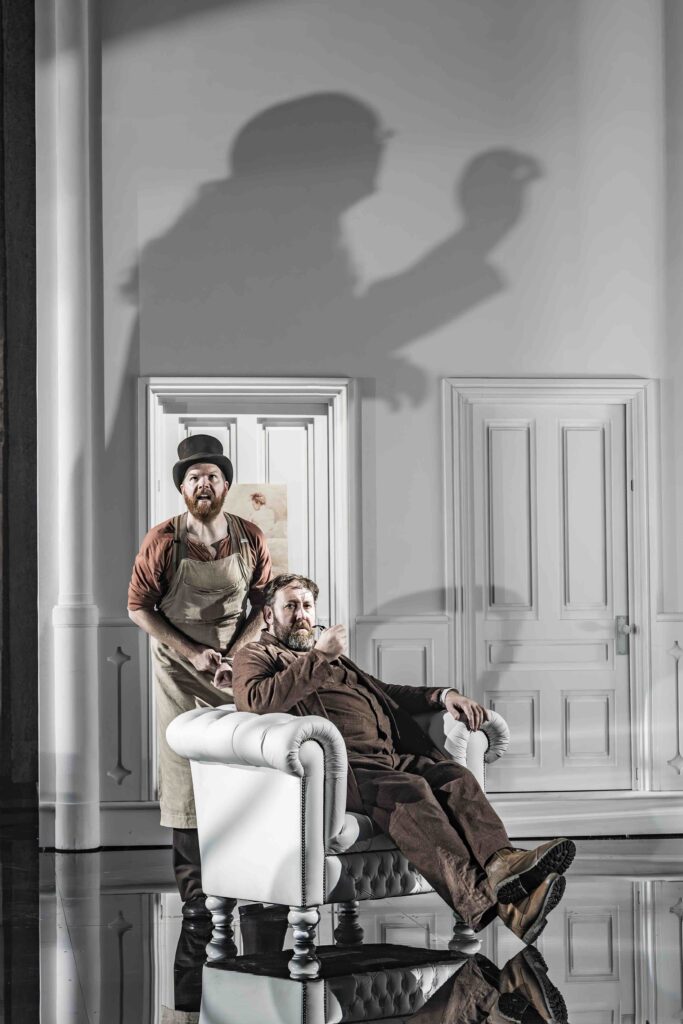
David Shipley and Matthew Rose
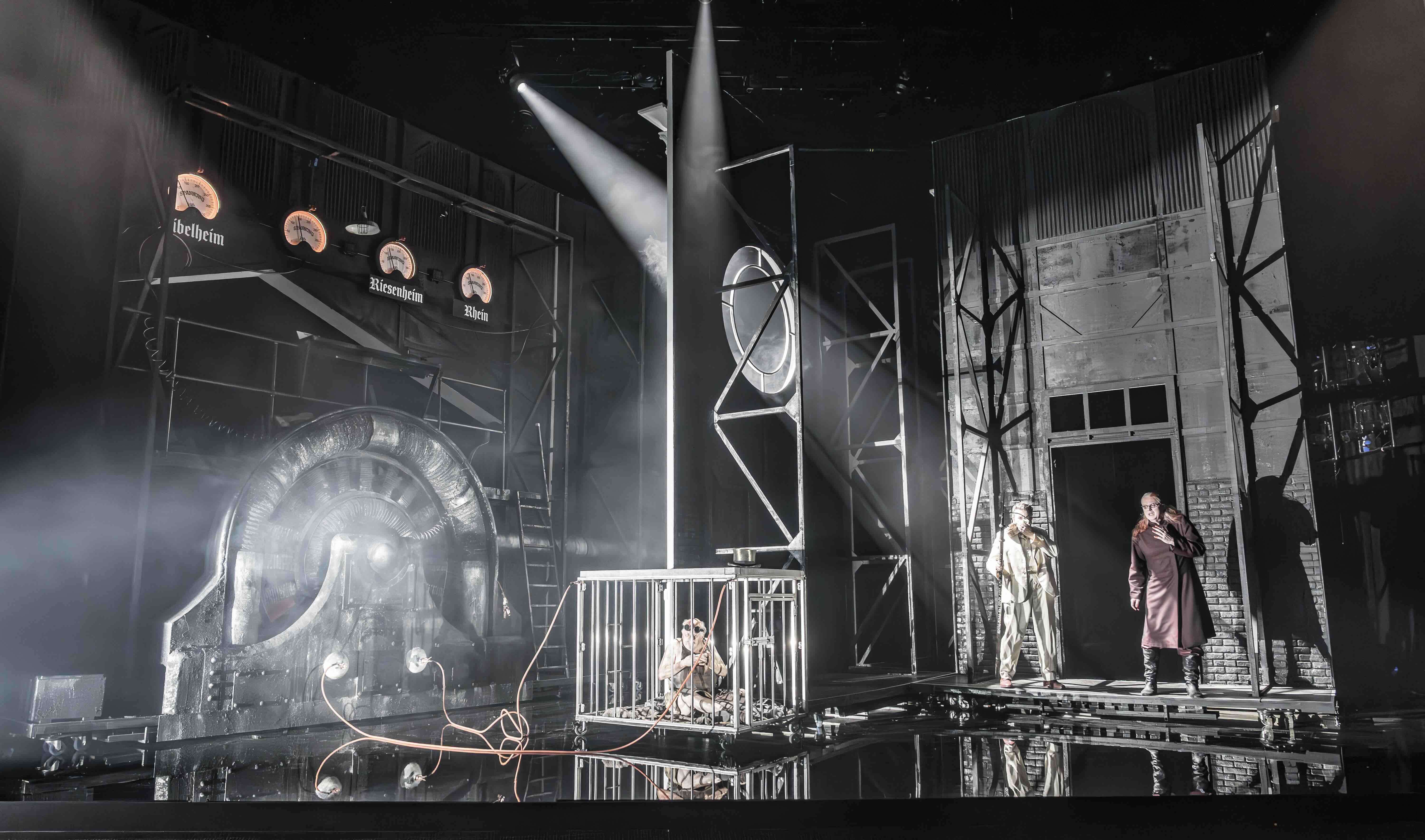
All ironic as Edwards’s whole concept is a world newly powered by electric current, generated down in Alberich’s domain and piped out to light the Rhine, the Nibelungs, Riesenheim and, much to the evil dwarf’s delight, the gods themselves. It all sits neatly with Wagner’s own suspicion of modern industrial society. So we have an opera by a composer who was alarmed by the danger of new industrial societies, whose greatest work is interpreted as about harnessing a new power – and then that jinxed, live, by that new power. So a metaphorical spanner in the works well before the god Donner takes an actual spanner (rather than his traditional hammer) to the fuse box the giants have wired into the palace that we see being built on stage.
Look past this and, judging by the audience lack of reaction to it anyway, and the show is a real pleasure to watch. Gabrielle Dalton dresses everyone in handsome late‑Victorian tailoring, perfect for a new industrial society, and the concept threads through cleverly. The Rhinegold itself is a glowing length of cable, which we see Alberiech (on another stepladder) pull out of a glowing orb. The gods are in a pristine white mansion, until they also get on the stepladder, to form the pediment of a cool Greek-style temple. It has all been created by those giants, although they are giants of their trade, carpenters and, of course, electricians.
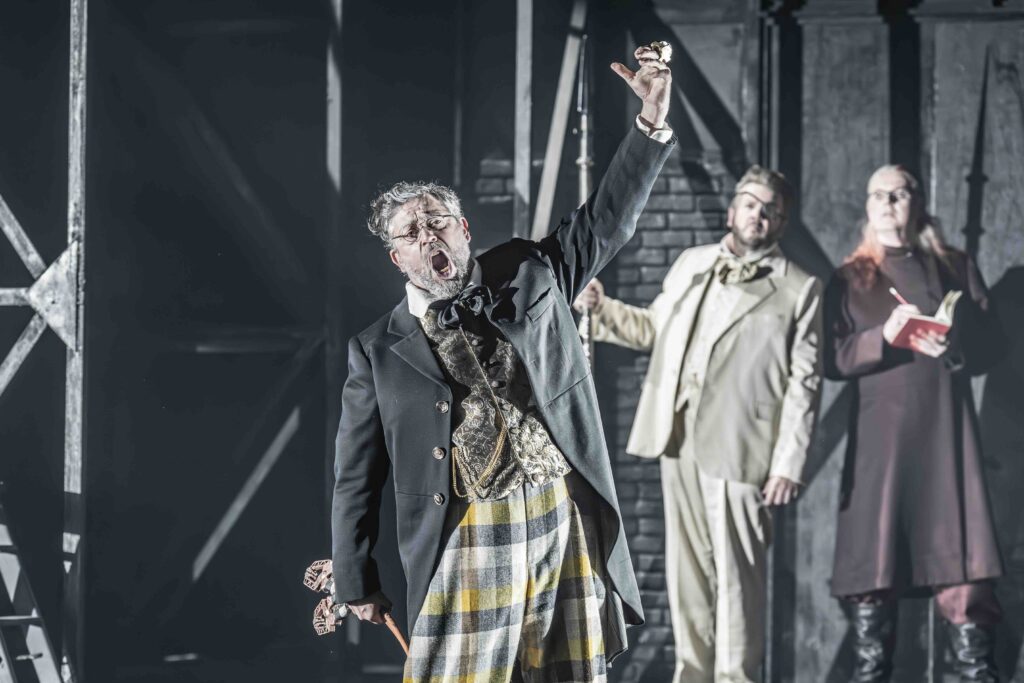
David Stout, James Rutherford and Mark LeBrocq
Best of all is Nibelheim, easily the evening’s visual high point: a gloomy power‑station control room, banks of dials charting the current as it pulses out to power the whole of Wagner’s world: the Rhine, Riesenheim, the Niebelungs, and finally the Gods.
In this industral generating station Alberich, dressed like a flashy industrial banker, gives his brother Mime some genuinely vile electric shocks, applied with what look like jump leads run straight off the vast generator, the same one, we assume, that smelts the gold. Mime, nicely taken by Adrian Thompson, is otherwise kept in a cage until Wotan and Loge spring him, and with not a single screeching Nibelung in sight he’s left to carry the entire scene alone, which he does. It would seem that Alberich was using electricity‑generated projections to pretend he was making magical transformations, which didn’t really make sense as you cannot capture an electrical shadow image of a toad. The dragon and the toad duly appeared flat on the gauze, and though neither frightens nor amuses, somehow it works. ?
Underneath it all there’s a smart Das Rheingold here. It’s a story about the cost of power: Alberich gives up love for gold, Wotan pawns his good name for a palace he can’t pay for. Edwards plays it as new money on the rise, and he knows the glitter is meant to corrupt, cleverly siting Alberich’s grubby domain behind the walls of Valhalla itself, the dirty labour shoved into the servants’ quarters of the gods’ own house. A sharp point about where wealth really comes from, even if it did mean the trip down to Albereich’s domain never felt like going down at all.
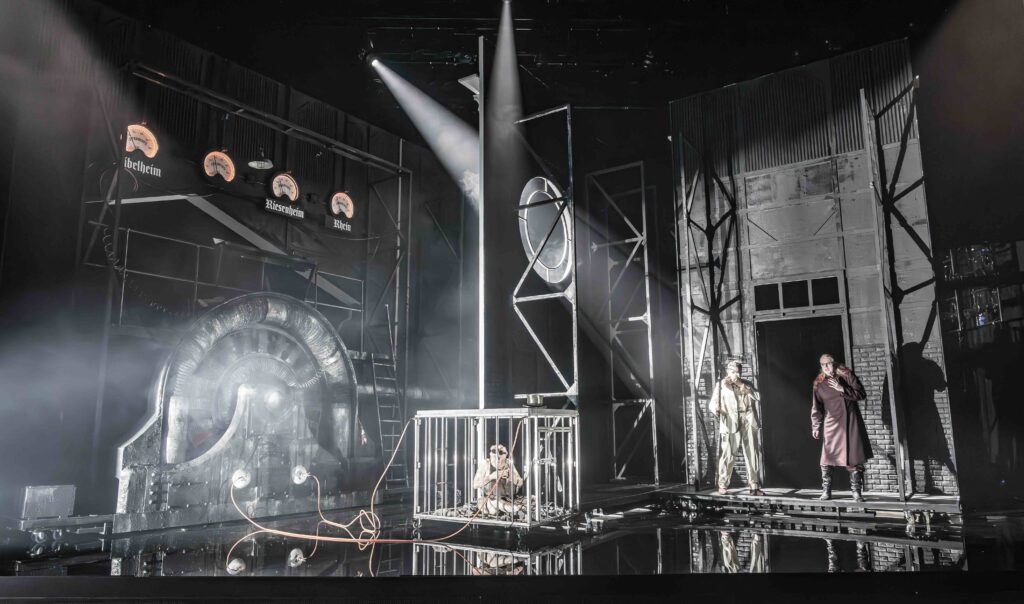
Adrian Thompson, James Rutherford and Mark LeBrocq
Production niggles aside, the singing carried it splendidly. For me the evening belonged to David Stout’s Alberich and the two giants, Matthew Rose’s Fasolt and David Shipley’s Fafner, a pair of brothers whose murderous falling‑out over the gold actually landed a blow. James Rutherford’s Wotan is a fussy god, forever wiping his hands after he brushes against anything grimy in Alberich’s world, as though a god cannot possibly mix with trade. Mark Le Brocq’s Loge spends the whole opera scribbling into a little notebook, keeping his own quiet tally of the gods’ bad decisions. Interesting, and, as I’ll come to, familiar.
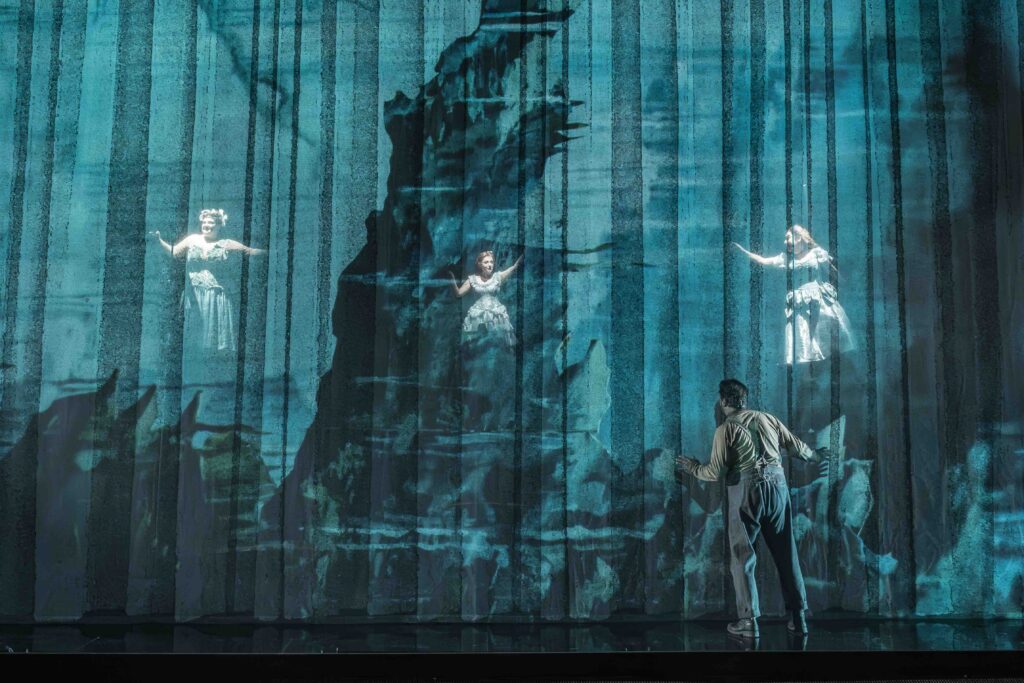
Ailish Tynan, Olivia Rose Tringham and Charlotte Bateman
Rachel Nicholls’s Freia was the one real heart in the room: genuinely stricken to be handed over to Fasolt, and the only soul on stage to grieve when Fafner kills him, everyone else simply moves on. Worth remembering her, too, as she’ll be back as Brünnhilde for the rest of the cycle. And the best surprise was Sara Fulgoni’s Erda, who rose to deliver her warning from a seat in the middle of the audience, the earth‑goddess surfacing among us mortals, all the more unsettling for it. Mind you, her look wasn’t all that outrageous next to some of the gloriously fun outfits Grange Park’s audiences turn up in.
Musically it was in safe hands. On the podium is Harry Sever, Anthony Negus’s protégé, who cut his Wagnerian teeth as the great man’s assistant at Longborough, and he draws real bite and colour from the Orchestra of English National Opera throughout. And here I can’t help myself. Two days later I was at Longborough, that other country‑house company, famously run out of a converted chicken shed, for Negus himself conducting Tristan und Isolde, and it was quite remarkable. Negus is still our reigning festival Wagnerian. This is also where the idea of scribbling in a book also seemed familiar as in Longborough’s own recent, excellent Ring also had a figure making notes in a book across all four operas.
So Grange Park’s Ring has got off to a very good start, and I’m certain that, were it not for the technical glitches, the evening would have been even better than the one I saw. There’s a neat symmetry in it, too: the crown for country‑house Wagner stays at Longborough for now, but with Negus’s own protégé already in the Grange Park pit, the master’s influence is spreading across the fields.
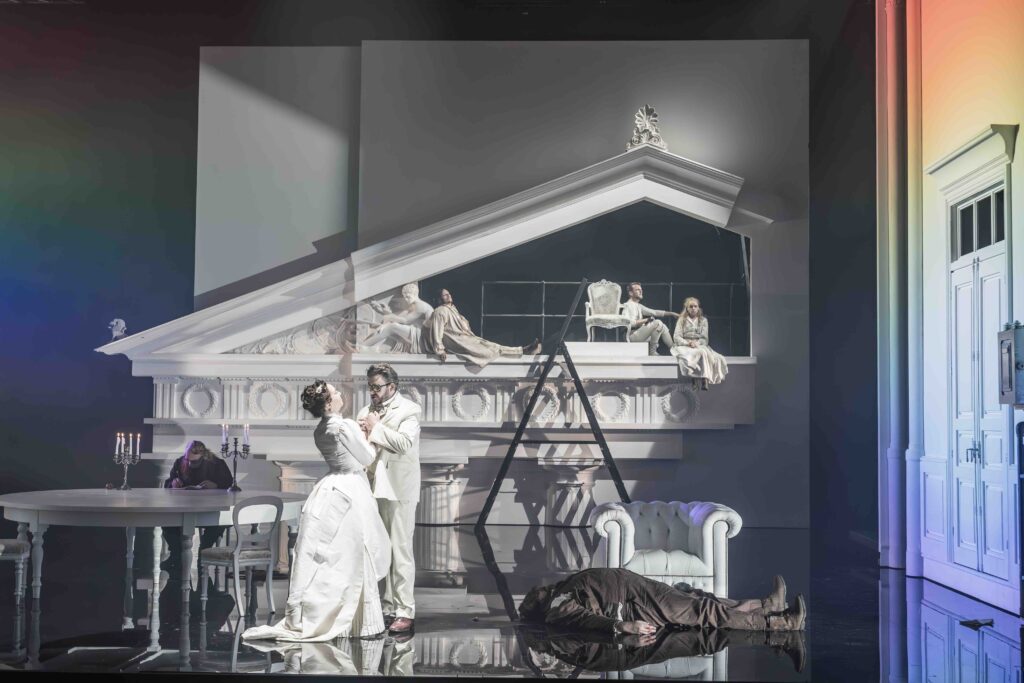
James Schouten, Christine Rice, James Rutherford, Thomas Isherwood, Rachel Nicholls
So: a heat warning that, fortunately, proved unnecessary, then technical gremlins, and beneath them a Das Rheingold of real intelligence and, once the fuses held, real power.
Das Rheingold, Grange Park Opera, Theatre in the Woods, West Horsley. Grange Park Opera’s Ring Cycle continues to 2029.
Images by Marc Brenner
