★★★
Mike Smith
I cannot remember the last time a Garsington audience laughed this hard for this long. People around me were in tears, a man two seats away applauded a smashed dinner plate, and by the time forty of them had been demolished in the great Act One row I was beginning to feel I was the only person in Buckinghamshire not entirely swept along.
Gerald Barry’s version first appeared in Los Angeles in 2011, reached the Linbury at Covent Garden in 2013 and the Barbican in 2016, and only now arrives at a country house. It runs a single breathless ninety minutes, and Barry has cut something like two thirds of Wilde’s text, describing what is left as an X-ray of the play. The sound world is deliberately deranged. Singers hurl their lines across vertiginous intervals, crockery is destroyed by the dozen to punctuate an argument, characters bawl at each other through megaphones, and Barry keeps grafting borrowed tunes onto his own hyperactive writing. It is the referenced material that stays with you afterwards: Auld Lang Syne wanders in, the Ode to Joy arrives with a completely straight face, and neither is treated with any more reverence than the dinner service. Douglas Boyd holds it together with real precision, and the Philharmonia players earn their fee several times over in a score that treats them as part of the comedy rather than the accompaniment.
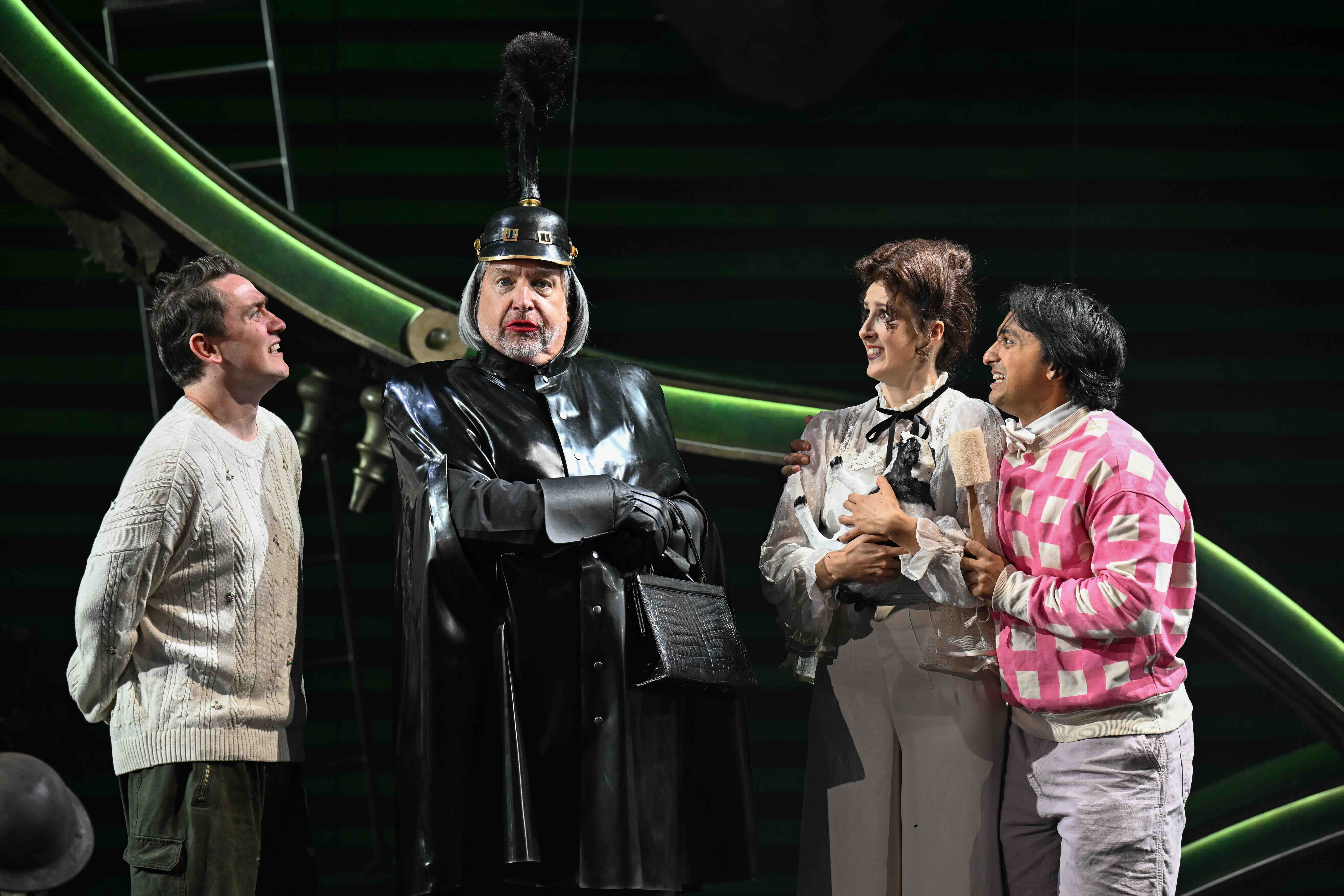
Jack Furness directs with tremendous invention and not a second is wasted. Francis O’Connor’s designs are a riot of clashing colour, Hannah Wolfe dresses the cast as though a dressing-up box had gone off in the wings, Paul Pyant’s lighting turns on a sixpence when the explosions come, and Rebecca Meltzer’s movement direction is what stops the whole enterprise collapsing into a scrum.
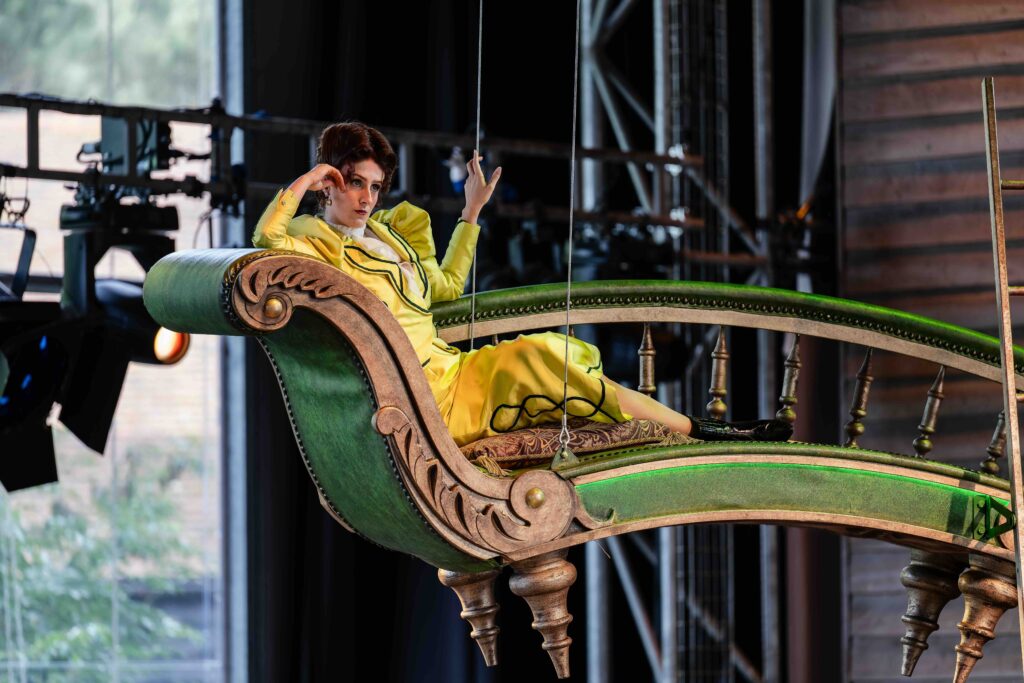
The cast is superb throughout, and Jennifer France is the reason to see it. Cecily’s writing is frankly cruel, sitting high and staying there, demanding leaps that look unsingable on the page, and France dispatches the lot with a gleaming, silvery tone that never once turns shrill or effortful under pressure. What is remarkable is that she makes something beautiful out of material designed to be absurd: the notes arrive dead centre, floated rather than attacked, and she does it all while grinning like a girl who has just got away with something. It would be easy in this production to treat the singing as one more piece of the mayhem. She refuses to, and the evening is much the richer for it. Holly Brown’s Gwendolen is her perfect adversary across the plates, matching her in poise and in venom. Seán Boylan and Zahid Siddiqui spar as Algernon and Jack with athletic glee, Susan Bickley is gloriously batty as Miss Prism, and Kevin Whately does a great deal without singing a note as Dr Chasuble. Peter Lidbetter takes both Lane and Merriman, deadpan throughout, and is worth watching all evening whichever butler he happens to be. Best of all for sheer comic effect is Henry Waddington’s monstrous Lady Bracknell, kitted out as a leather-clad officer at a checkpoint and very funny indeed. Nobody could act or sing this better, and the ensemble discipline needed to keep it all airborne, at speed, without a break, is frankly heroic.
And there, for me, is the problem. The invention never lets up. Somebody mentions Australia and a kangaroo promptly bounds on, which is fair enough, but Furness then takes Tie Me Kangaroo Down, Sport a good deal more literally than the song intended and has the wretched animal hanged in the second act, which struck me as a touch severe. It was a good deal more fun when it was alive, and I would happily have watched it hop off into the Garsington gardens and take its chances with the deer. Fortunately there was no sign of a didgeridoo. There is real cleverness in all of this, notably the moment a Victorian sofa unfolds into a slide to audible gasps of delight, but even the wittiest strokes kept veering close to sliding, if you will pardon the word, into clever clever farce. What goes missing along the way is the bite. Wilde’s entire method is language, the written and the spoken word deployed with absolute precision to satirise the English upper class and, let us be honest, to show off his own wit while he was about it. Here that precision is traded for surreal nonsense, and nonsense, however inspired, cannot draw blood. Mayhem sustained without a break stops being subversive and becomes merely loud. Wilde’s wit depends on poise and timing and the pause before the blade goes in, and it gets rather trampled in the rush. Take the staging away and I doubt the score would hold a concert audience for ninety minutes on its own. It needs the kangaroo.
Stephen Fry famously compared turning the play into an opera to “taking a machete to a soufflé”, which is a good line and an ironic one, coming from an actor who has not only played Oscar Wilde himself in the 1997 film but has also climbed into Lady Bracknell’s frock on stage and physically embodied the author’s sharpest creation. Then again, Fry does love showing off his knowledge, which is not at all the same thing as intelligence, and Wilde would have spotted the difference before the soup arrived.
All of which points to the road not taken. Bunburying, for anyone who has managed to avoid the play, is Algernon’s word for the invention of a fictitious friend, the permanently ailing Mr Bunbury, whose supposed ill health provides a respectable excuse to disappear whenever duty threatens, while Jack runs the same racket in reverse with an imaginary wastrel brother in town. It is not exactly a secret that Wilde was describing his own arrangements. He too kept a second self and a second address, and the whole play hums with the pleasures and the terrors of the double life he was living while he wrote it. A braver director would have gone straight at this, and the material could hardly be more willing: two young men absorbed to a quite remarkable degree in each other’s fictions, courting two women who are in love with a name rather than a man, and a plot whose entire engine is concealment. Furness has already put a bearded bass in Lady Bracknell’s frock, so the question of who is performing what, and for whom, is sitting there in plain view. The choice could have been the production’s sharpest stroke, a man performing the very respectability that would later destroy Wilde; instead it is played for the frock and the laugh, and the point goes begging. This production even engages an intimacy director, Haruka Kuroda, which suggests somebody had thought about what is going on beneath the surface, and yet having gone that far it seems a pity to stop at slapstick. There is a genuinely dangerous production of this piece waiting to be made, and this is not quite it. And it is worth asking whether the whole romp lands differently for a gay member of the audience than for the rest. What plays as harmless fun turns rather colder when you remember that Wilde’s own Bunbury was not a comic device but a survival strategy, and that the very society he was so delicately sending up in these social comedies put him in Reading Gaol the moment his double life came into the open. The play is soaked in that danger, and a production that reduces it to slapstick is enjoying the joke while stepping around the thing that makes it serious.
Which leaves the shock. Furness plainly believes he is administering a corrective to a genteel art form and a genteel audience, but the Garsington crowd treated every outrage as an invitation to enjoy themselves, and enjoy themselves they thoroughly did. There was an irony in it, too: a good part of that audience belonged to the very class Wilde was skewering, and on the evidence of the laughter it was lost on them entirely — they laughed as though it were about somebody else. Nothing here alarmed anybody. It is enormous fun, magnificently done, and a good deal less dangerous than it thinks it is.
