***
In Dorset Opera’s Samson et Dalila the voices are strong, the chorus exemplary, and Jeremy Carnall’s orchestra plays with real conviction.
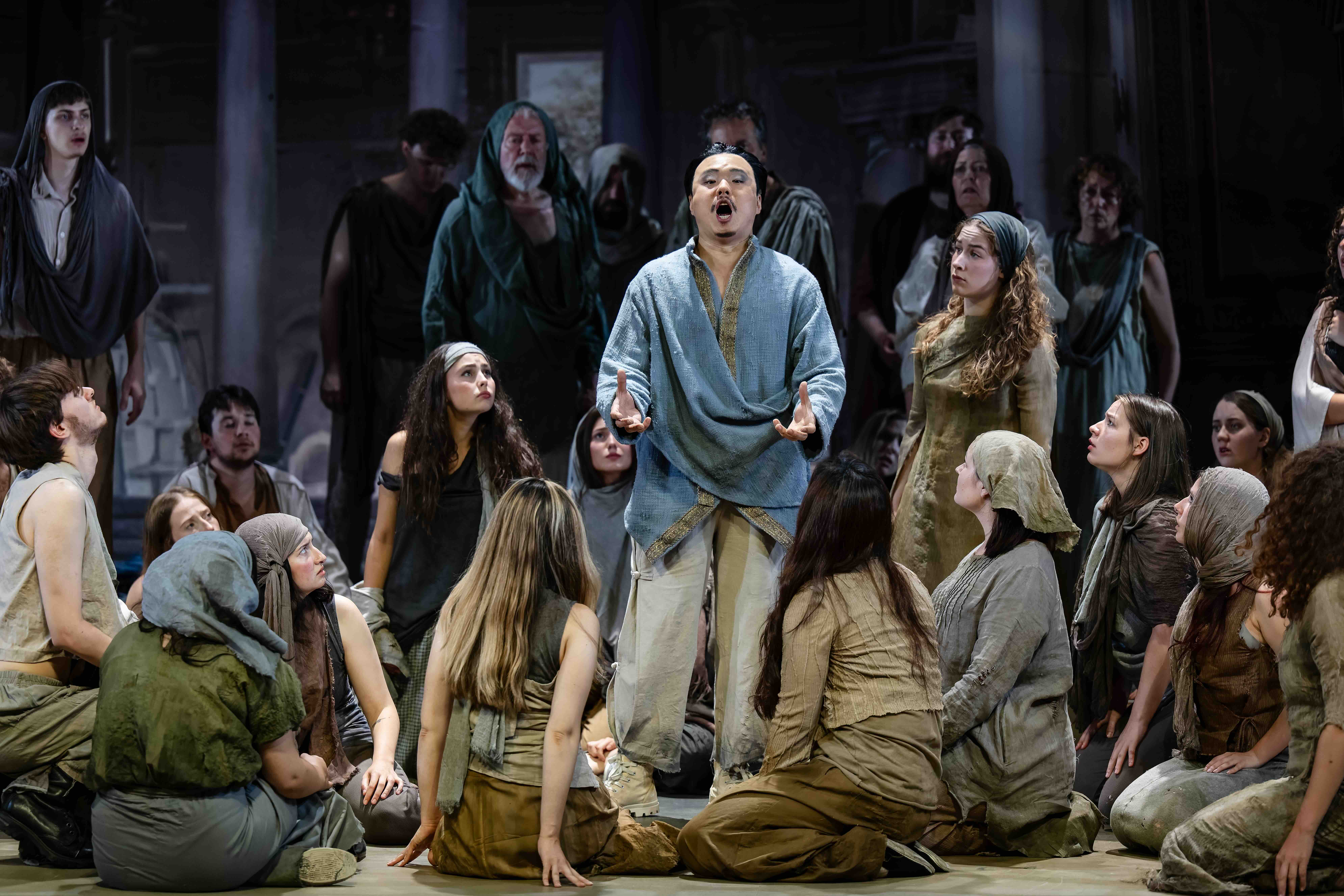
Rufus Martin gives us a single set, a heavily damaged temple, and it stays put all evening. At first I took it for the wrecked place of worship of the conquered Jews, which reads perfectly well; by the close it has become the Philistines’ own temple, the one Samson brings down about their ears once his strength briefly returns.
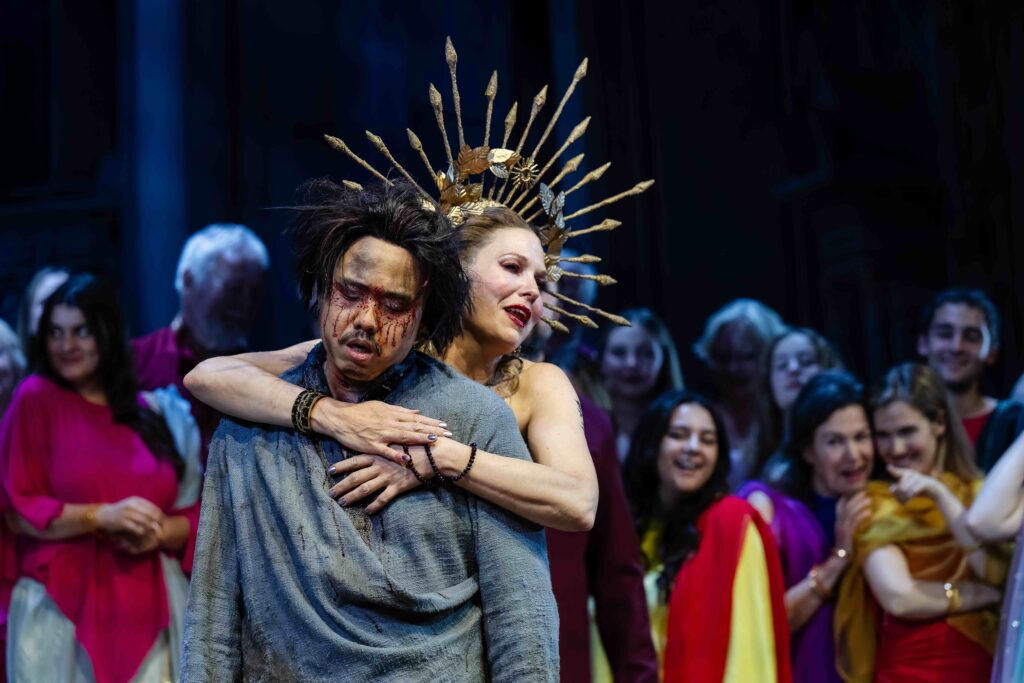
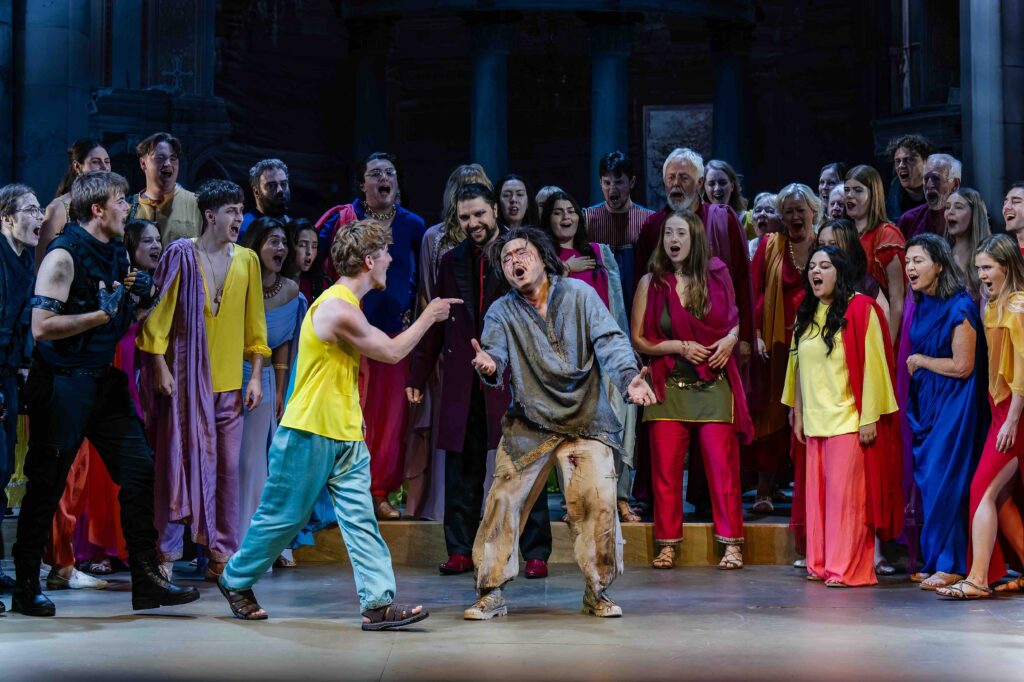
Who Whi Choi and Mae Haydorn
The idea, I think, is not to anchor the story to any one place or period, the ruin standing instead for the wars that go on disfiguring our own world, and as a concept it has real force. History is one long procession of religions arriving and departing, their temples raised and then reduced to rubble, and the process shows no sign of stopping in our own century; a single ruined sanctuary standing for all of them makes perfect sense. Libby Watson’s costumes reflect this timelessness but the upshot is that anyone arriving without a working knowledge of the opera, or of the Book of Judges, might find it hard to tell whose temple they were looking at, or why it lay in ruins before the trouble had even begun.
Happily, the strength of the singing gives the evening a secure foundation. Mae Heydorn’s Dalila is the finest thing here, her voice a rich, dark instrument used with genuine intelligence, and there is real depth. Printemps qui commence was shaped with lovely ease, and Mon cœur s’ouvre à ta voix floated out with the sort of unhurried confidence that makes an audience forget to breathe. She colours the French beautifully and never once pushes for effect. Alexey Gusev’s High Priest of Dagon is a genuinely frightening creation, sung with a big, unyielding baritone and acted with obvious relish for the man’s cruelty. Jonathan Eyers makes Abimélech thoroughly unpleasant in the short time the part allows him, and Aidan Smith brings a warm, steady bass to the Old Hebrew, pleading with Samson to remember his God and forget the woman. Both, incidentally, carry principal roles in the festival’s L’elisir as well.
The Samson of Won Whi Choi, making his UK debut, grows with the performance. In the first act he seemed a little uninvolved, the voice impressive but the character not quite arrived, and I did begin to wonder how the evening would go. After his downfall, he rose to the role and finally carried the full weight of the tragedy. His final scene in the temple was genuinely powerful.
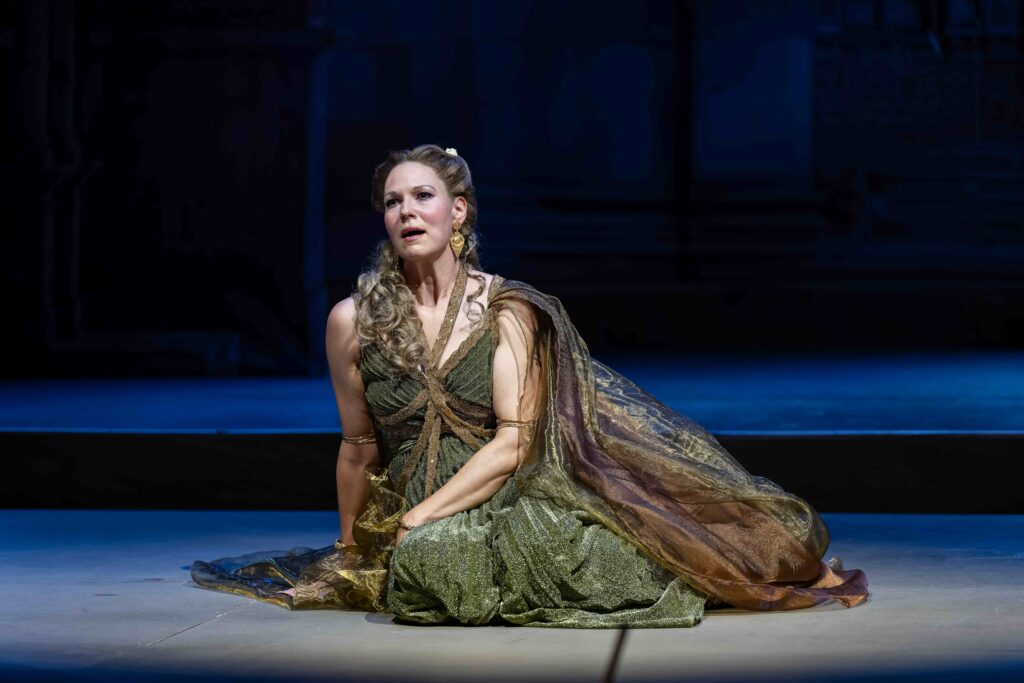
Mae Haydorn
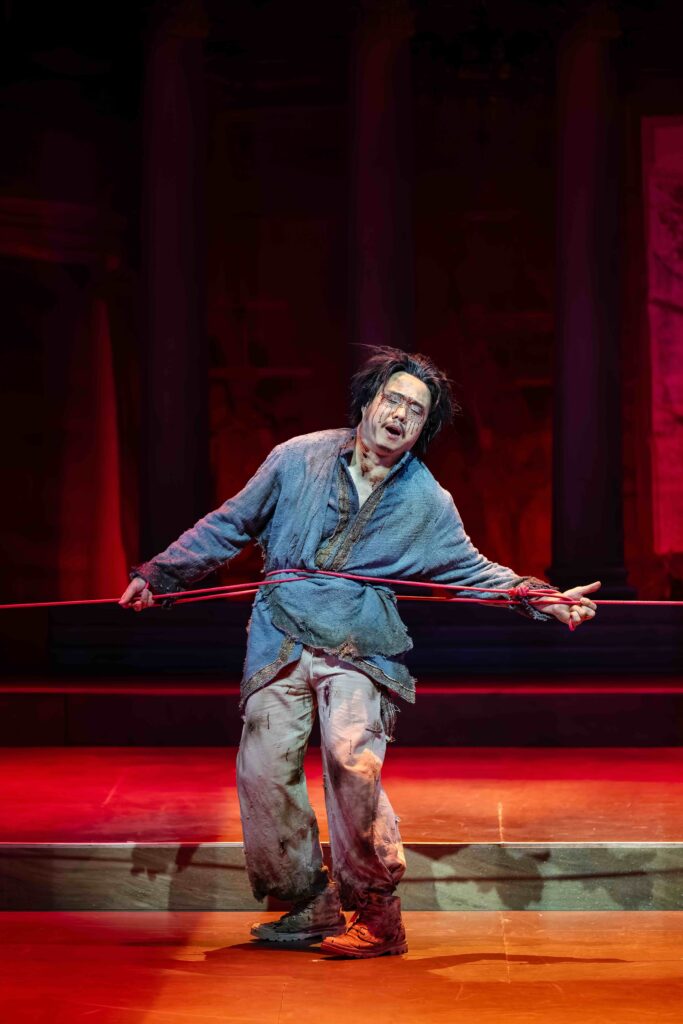
Won Whi Choi
Whether a direction choice, there is little heat between the two of them until after that fateful hair cut and Dalila had her work cut out with so contained a Samson. The moment she finally takes the shears to him has hair-raising consequences, his acting springs vividly to life.
Then there is the red cord. A length of scarlet rope appears at intervals to bind Samson, and at other moments to bind or connect various other people, and I confess that by the end I was no longer sure what it was meant to signify. Fate, perhaps. Bondage, possibly. The ties of faith, at a stretch. Whatever the intention, its meaning stayed just out of reach. A production this well sung hardly needs a symbol that has to be puzzled over.
Curious, too, is what happened to the surtitles. Saint-Saëns and Ferdinand Lemaire are not coy: the Hebrews call on the God of Israel, they sing of Israel breaking its chains, and the word rings out repeatedly from the stage in perfectly audible French. Yet the English surtitles gently set the name aside. Given Carr’s declared wish to avoid tying the piece to any one conflict while the Middle East burns, one can quite see the thinking; it is simply thinking that struggles to survive contact with the stage. The opera is a biblical story about the Israelites and the Philistines, drawn from the sixteenth chapter of the Book of Judges, and has been since 1877. Nobody comes to Samson et Dalila expecting a position paper on the Middle East, and having the surtitles say something other than what the singers are plainly singing doesn’t really make the difficulty go away; it only leaves the surtitles a step out of step with the stage.
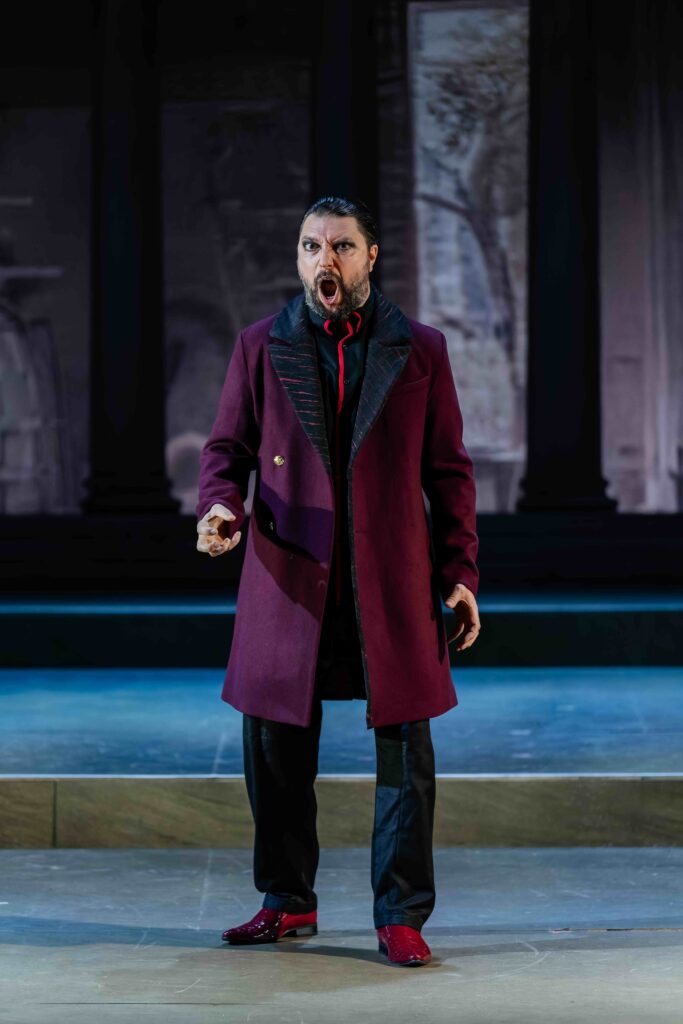
Alexey Gusev
Yet it was the choreography for the chorus where I was least persuaded. Alicia Frost’s intentions in the Bacchanale are plain enough, and interesting: she has gone for menace where we normally get erotic display, giving us a knot of fighters revelling in conquest, and on paper that is a thoroughly good idea. In place of sensuality we got some heavy stomping from a band of rough-looking henchmen, while elsewhere the Philistines spent much of the evening undulating and waving their arms in a way that put me more in mind of a wellbeing class than a decadent civilisation on the brink of divine punishment. In the Bacchanale, where the score positively asks for abandon, we got busyness instead.
There was some fun to be had, in watching the stomping heavies of one evening reappear as the battered, boozy and thoroughly lecherous kilted soldiers of the festival’s other offering, Donizetti’s L’elisir d’amore.
The chorus, trained by Stephen Harris, is the beating heart of this festival and was on magnificent form, throwing itself into the drama as wholeheartedly as into the singing: the opening lament had weight and desolation, and the great choral outbursts filled the Coade Theatre in a way that reminds you why you make the journey. Carnall kept the pit tidy and secure throughout, and Saint-Saëns’s marvellous orchestration, all incense and menace, came through vividly. Through no fault of Dorset Opera, the evening’s enjoyment was tested by the sweltering heat; a few people slipped away, and at one low point even I thought, forgive me Dalila, I’m not sure I can take much more. But unlike Samson, I kept the faith.
So a hot evening, and an oddly divided one. On the purely musical side this is a considerable achievement, superbly sung and finely played, and there were long stretches when I simply let the staging recede and listened. If some of the acting wanted dynamism, and the chemistry between the lovers never quite arrived, vocally there was no such doubt: Choi’s Samson grew steadily in power across the evening and ended in commanding voice. But an opera about desire does need some desire, and an opera about a doomed civilisation needs that civilisation to look dangerous rather than just a little daft. Paul Carr has assembled the ingredients, and some genuinely interesting ideas, but the end result was a little shaky.
Images Julian Guidera
Also at Dorset Opera Festival 2026:
