★★★★
There are two things that keep me coming back to Dorset Opera, and both were in ample supply here. One is a chorus of a size that lets it do what a chorus is actually supposed to do, and the other is musicianship of a standard that would embarrass companies with ten times the budget. Put those together with a production as lucid and as level-headed as Andy Morton’s and you have an evening that sends you home grinning.
The setting is Victorian, and it works a treat. Rufus Martin’s autumnal sets and Libby Watson’s costumes give us a village of apple trees and hedgerow and hard work, plainly English rather than notionally Italian. That it is meant to be Dorset comes across mainly through the surtitles, couched in a curious rustic idiom that I was assured is how a Dorset country person would genuinely speak, though sitting in Blandford Forum the audience is rather well placed to judge that for itself. The same surtitles have Dulcamara palming off Plymouth Gin as his miracle cure.
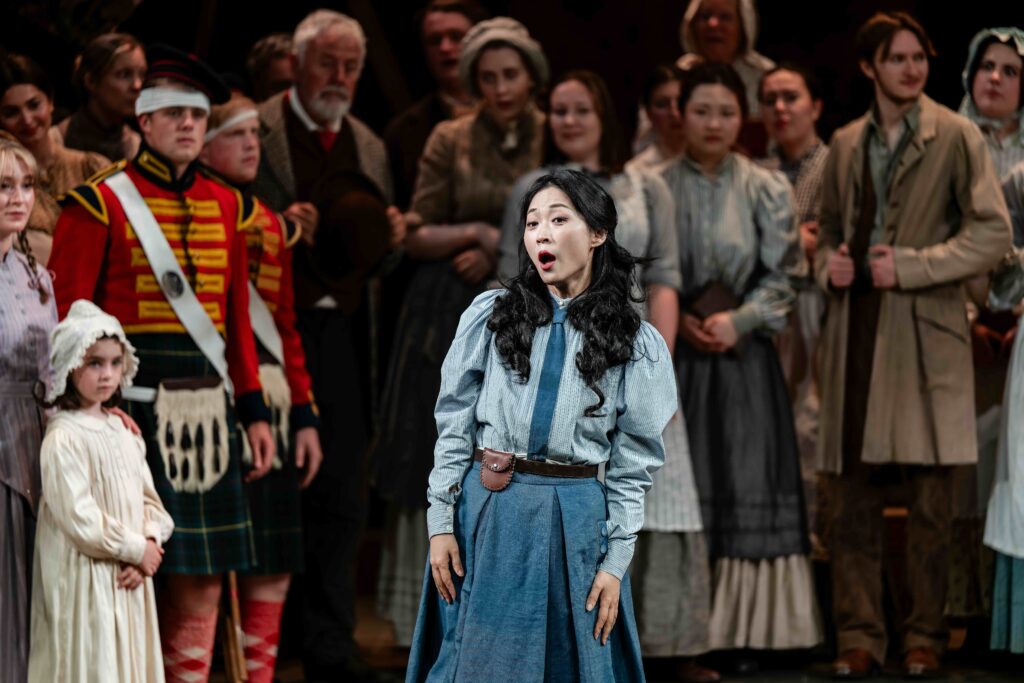
Haeran Hong
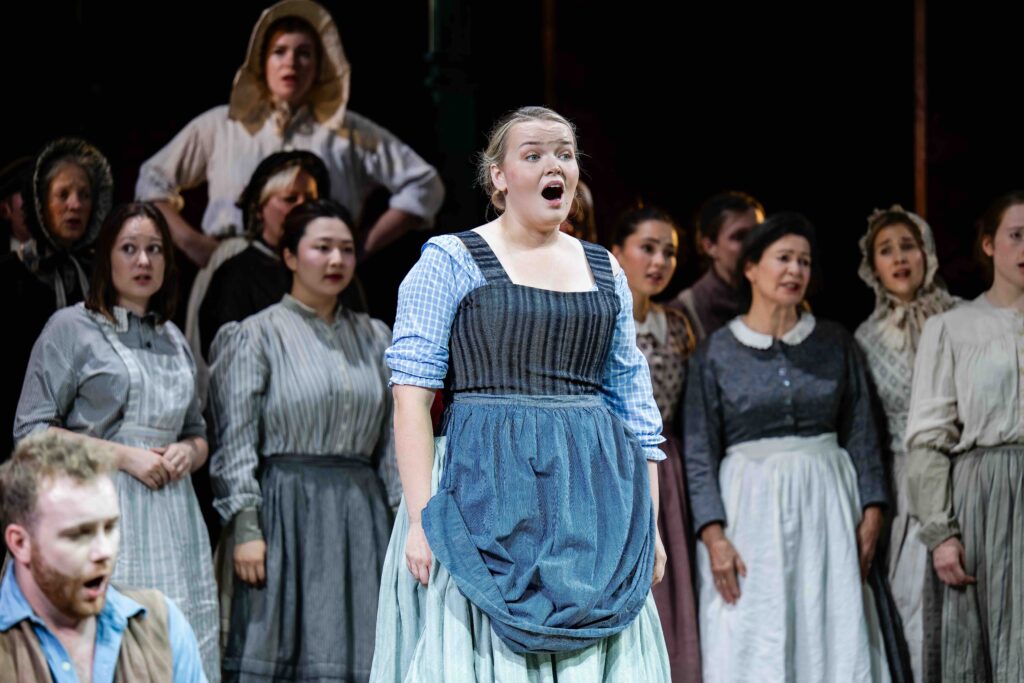
Daisy Lapworth
Then the industrial age comes clanking in, with the quack arriving by steam train and Belcore dispatched on a later one once he has been seen off. This is a shrewder touch than it first appears. The coming of the railway to Blandford was one of the great events of the town’s Victorian century, and it left its mark everywhere: the industrial architecture that still survives, and the hotels and public houses that took railway names and kept them. An audience sitting a couple of miles away will need no footnote. In one stroke the production tells us that the outside world has arrived in this valley, and that nothing in it will be quite the same again.
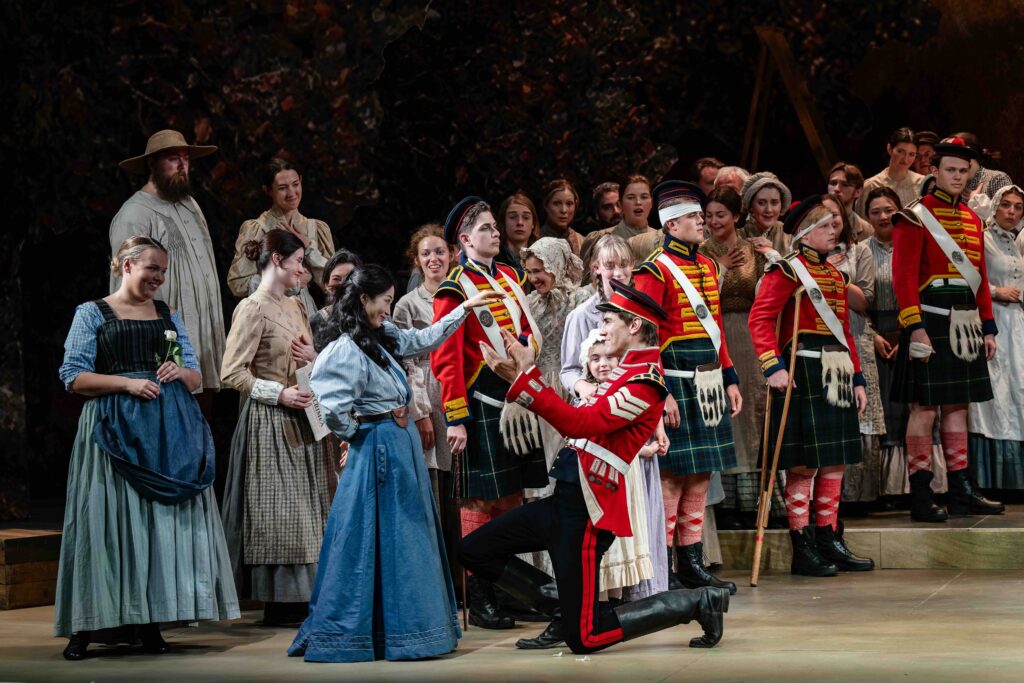
Nor does it take a great leap to work out whose county this is. Put a farm mistress of independent means, a swaggering soldier in uniform and a decent, patient farmhand into a Dorset village and you have Bathsheba Everdene, Sergeant Troy and Gabriel Oak. This is Far from the Madding Crowd with tunes, and the characterisations bear it out: Haeran Hong’s Adina has Bathsheba’s brisk self-possession and her habit of toying with an admirer to see what happens, Eyers’s Belcore has Troy’s scarlet swagger and shallow charm, and Broadhurst’s Nemorino has Oak’s patience and his refusal to give up. The local resonance does half of Morton’s work for him, and it gives the piece a weight of real feeling that the usual sun-baked Italian picture-postcard staging never manages.
The direction is where it all truly scores. As Adina, Haeran Hong is spot on, bright and quick-witted in the coloratura and not once just decoration. She lets you see the calculation behind the teasing, and when the tenderness finally surfaces it lands because she has kept it hidden so carefully. Her tone is warm where it could so easily be glassy, which suits a Victorian farm mistress far more aptly than the usual porcelain approach.
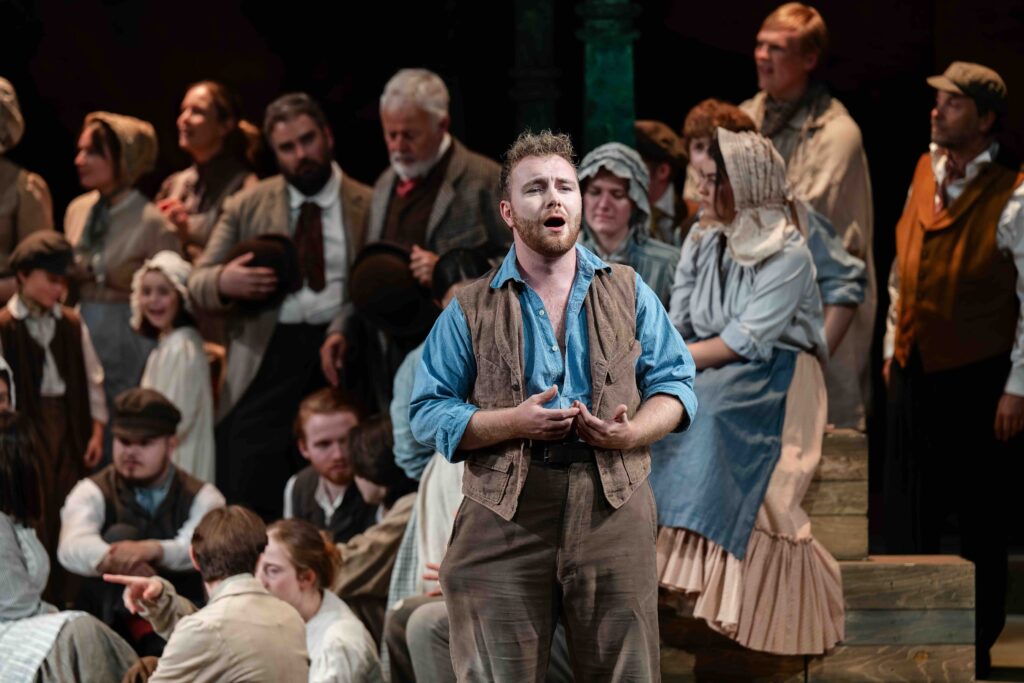
Jay Broadhurst
Jay Broadhurst’s Nemorino holds it all together. At twenty-four he is very impressive and never tips into the ridiculous. Una furtiva lagrima was beautifully judged, quiet and unforced.
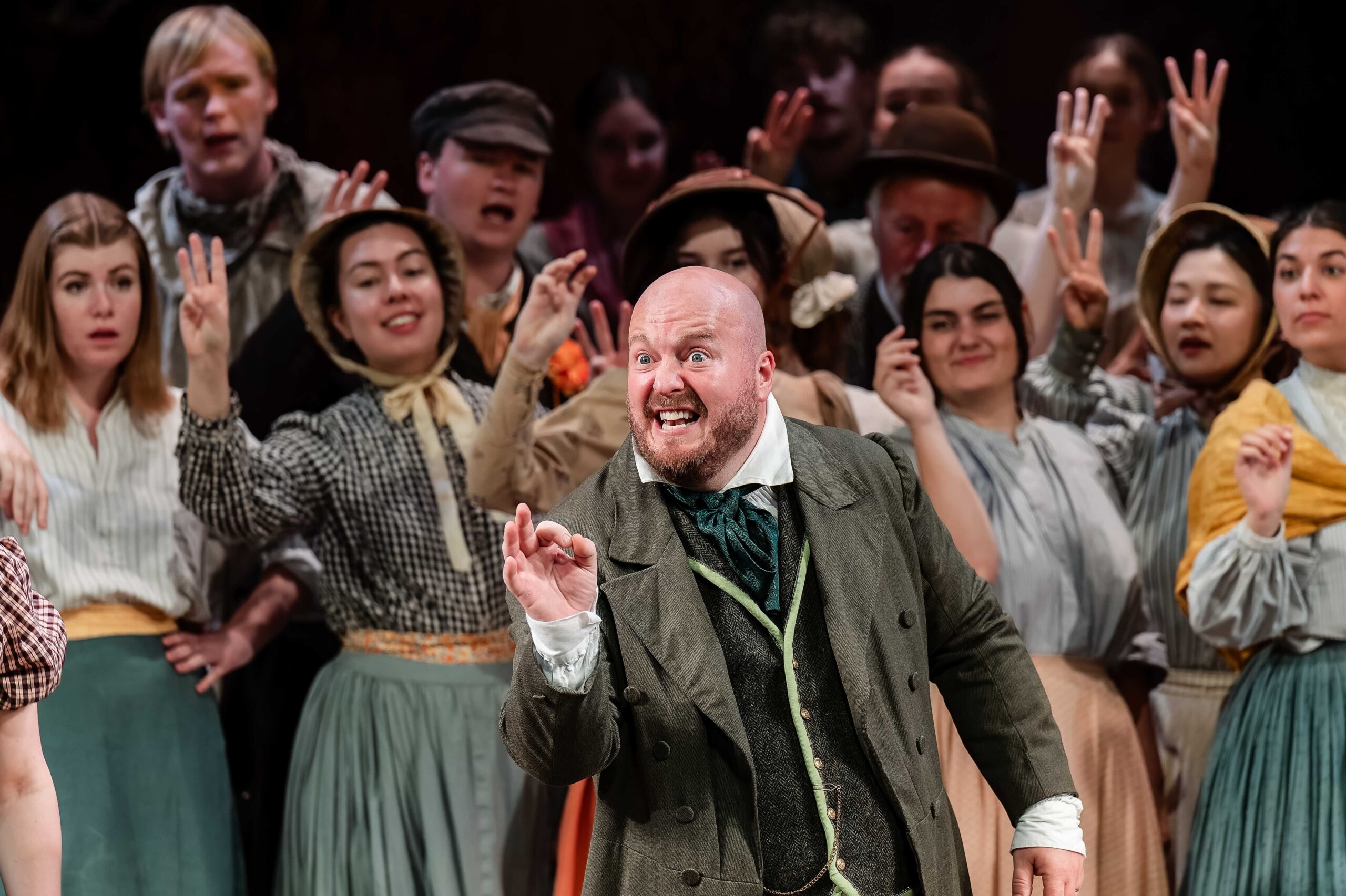
Jonathan Eyers gives us a Belcore of enormous self-regard and not much self-knowledge, strutting about in his kilt entirely sure he is God’s gift, and singing with a firm baritone that makes the swagger funny rather than tiresome. Best of all is Aidan Smith’s Dulcamara, a quack of tremendous charm and absolutely no shame, working the crowd like a market trader who knows the police are three streets away.
The patter is crisply delivered, every word audible, and the comic timing superb. His scene gambling with Belcore is one of the night’s delights, two chancers sizing each other up over the cards, each convinced he is the cleverer man and both quite wrong. Daisy Lapworth gets far more out of Giannetta than the part normally allows, and the gossip scene is all the better for it.
One of the glories of the evening, as so often here, is the chorus, expertly drilled by Stephen Harris. Dorset Opera fields numbers most houses can only envy, and when they all pour onto the stage the effect is genuinely thrilling in a way that no amount of clever design can replace. The choreography is top drawer throughout, and the scenes with the village women are the best of it, alive and detailed.
There is a splendid bout of apple bobbing, heads down in the tub and villagers coming up soaked and triumphant, which raises a proper laugh and roots the whole thing in an English country summer. You can watch any corner of the stage and find somebody doing a job of work. When the news of Nemorino’s inheritance goes round and the women descend on him, the staging is so well drilled that the comedy looks after itself.
Frank Zielhorst has the orchestra on cracking form, judging his tempi shrewdly. This, along with that chorus, is what makes a trip to Dorset Opera such a particular pleasure.
There is nothing here that is trying to shock anybody, and thank goodness for that. What there is in its place is a production that trusts its piece, leaves you in no doubt about the story, finds the laughs and lets them come naturally, and then quietly breaks your heart for a minute and a half in the second act. Add a company of singers who are plainly enjoying themselves enormously, and you have exactly what a summer opera festival ought to be.
Main image Aidan Smith
Image © Julian Guidera 2026
Also at Dorset Opera Festival 2026:
