
***
The audience showed itself very enthusiastic for director Bintou Dembélé‘s dance troupe’s hip-hop, whooping, and jumping, swirling and twirling, at the curtain call of this first UK staging of Rameau’s Les Indes galantes.
This ‘choreographed concert’ performance has developed from a staged production at the Opéra de Paris back in 2019 and has whooped its way around Europe. It ends like those musicals at our regional theatres when the audience gets to its feet and joins in the frivolity on stage, although at Grange Festival there is a lot of people in dinner suits getting down with the kids. Energetic and lively it certainly was, and, thank goodness. it was musically superb.
This performance, while greatly to be lauded for taking place, made me keen to find a staging that contained, well, dance that is beyond hip-hop. I am sure from Dembélé’s company Structure Rualité is great at what they do and have made a big name for themselves in France. It is the sort of choreography that has some story-telling in some of the movement although it was more an assemblage of dramatic vignettes with a lot of walking around in circles, lots of hair twirling and foot banging. Think that long running stage show Stomp set to baroque music and singing. No doubt it gets round the problem of a 1735, ballet héroïque concerning the Enlightenment’s obsession with the noble savage as Europeans encountered others.
So that is enough about that. The Grange Festival audience enjoyed it and I am sure that is all that matters.
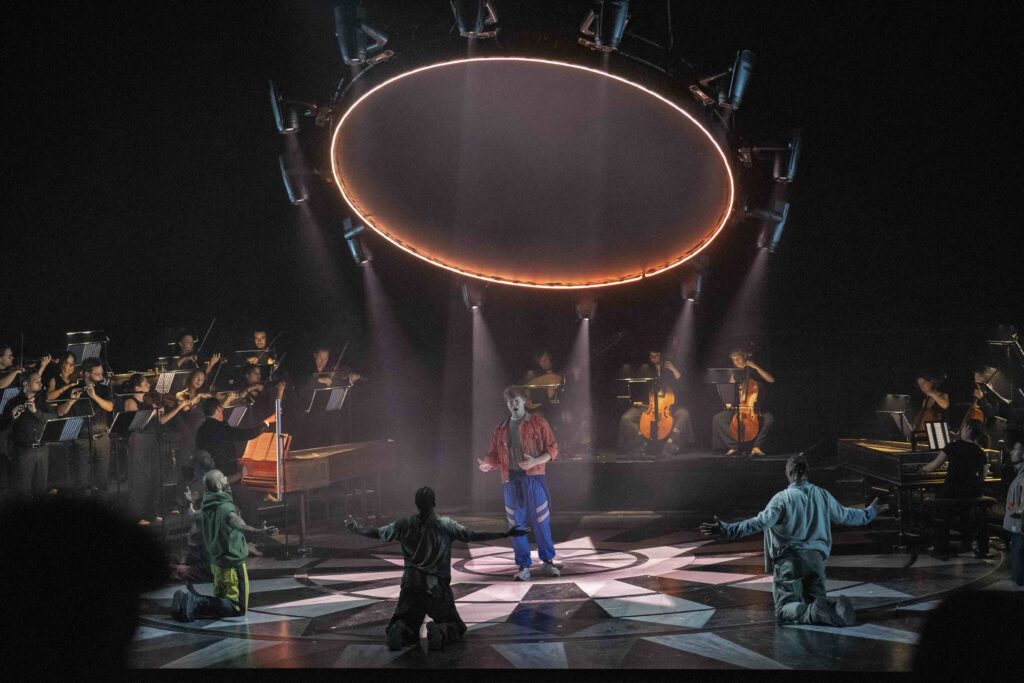
Andreas Wolf
Beyond the body popping (if that is the right expression) the huge delight of the performance belonged to the quite remarkable musicians from Capella Mediterranea playing under founder and conductor Leonardo García-Alarcón, the baroque voices of the Belgian Choeur de chambre Namur and four exquisite soloists, the fabulously voiced Ana Quintans, the contrasting style of Laurène Paternò, a sonorous and captivating Andreas Wolf and a bright high tenor of Alasdair Kent (all of whom sadly disappeared into the background during that curtain call partying). The singers created an evening of the most elegant singing. Kent even cartwheeled off the stage.
This sort of choreographed concert was performed on a bare stage, with those glorious musicians on rostra at the sides, and at the back, and occasionally brought to the front. Leonardo García-Alarcón (why barefoot?) conducted sometimes from the keyboard and often in the midst of things. Similarly the choreographer also put herself centre stage at times for some reason.
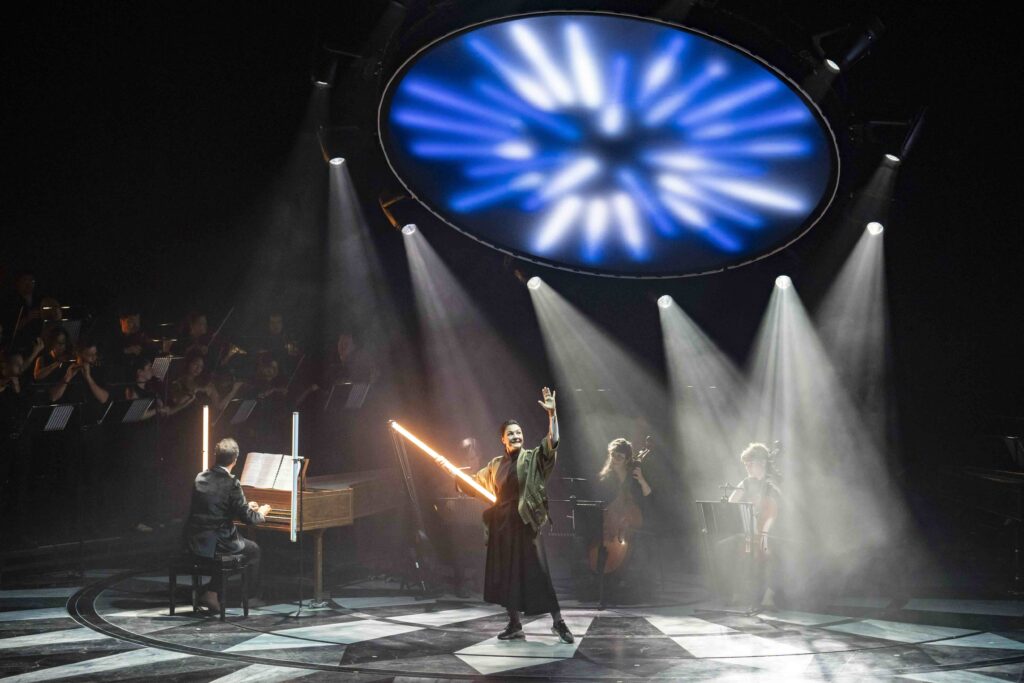
Ana Quintans
The Grange Festival space was well used with some of the musicians, singers and dancers appearing here and there in the auditorium making it also feel thoroughly immersive. We have singers and musicians on the balconies, soloist amongst the audience, and for some reason the choreographer decided to pop up in the stalls.
Most effective was lighting designer Benjamin Nesme’s ever-present suspended circle does work effectively in conjuring up the different settings for what is a collection of mini-stories around exotic locations, Turkey, Peru, Persia and the North American wilderness.
As also used effectively at Longborough Opera with their minimalist Pelléas et Melisande this season, the light sticks either on stands or taken from the suspended circle, are used to illuminate the singers.
Looking like something picked up in a jumble sale, Charlotte Coffinet’s street clothes costumes presumably aimed at also being down with the kids.
For me this is a close your eyes and enjoy glorious music and singing show and just take a little peak to see what the body poppers are up to. Yes, this is a deeply problematic work to stage in the 21st century so perhaps sticking to a concert performance would be best. However, there have been some exquisite full balletic stagings, so perhaps I am really just 500 years old and do not like hip hop.
After the long picnic interval the singing and musicianship in acts 3 and 4 (The Flowers and The Savages) were just wonderful and made the evening utterly memorable.
Images Richard Hubert Smith
