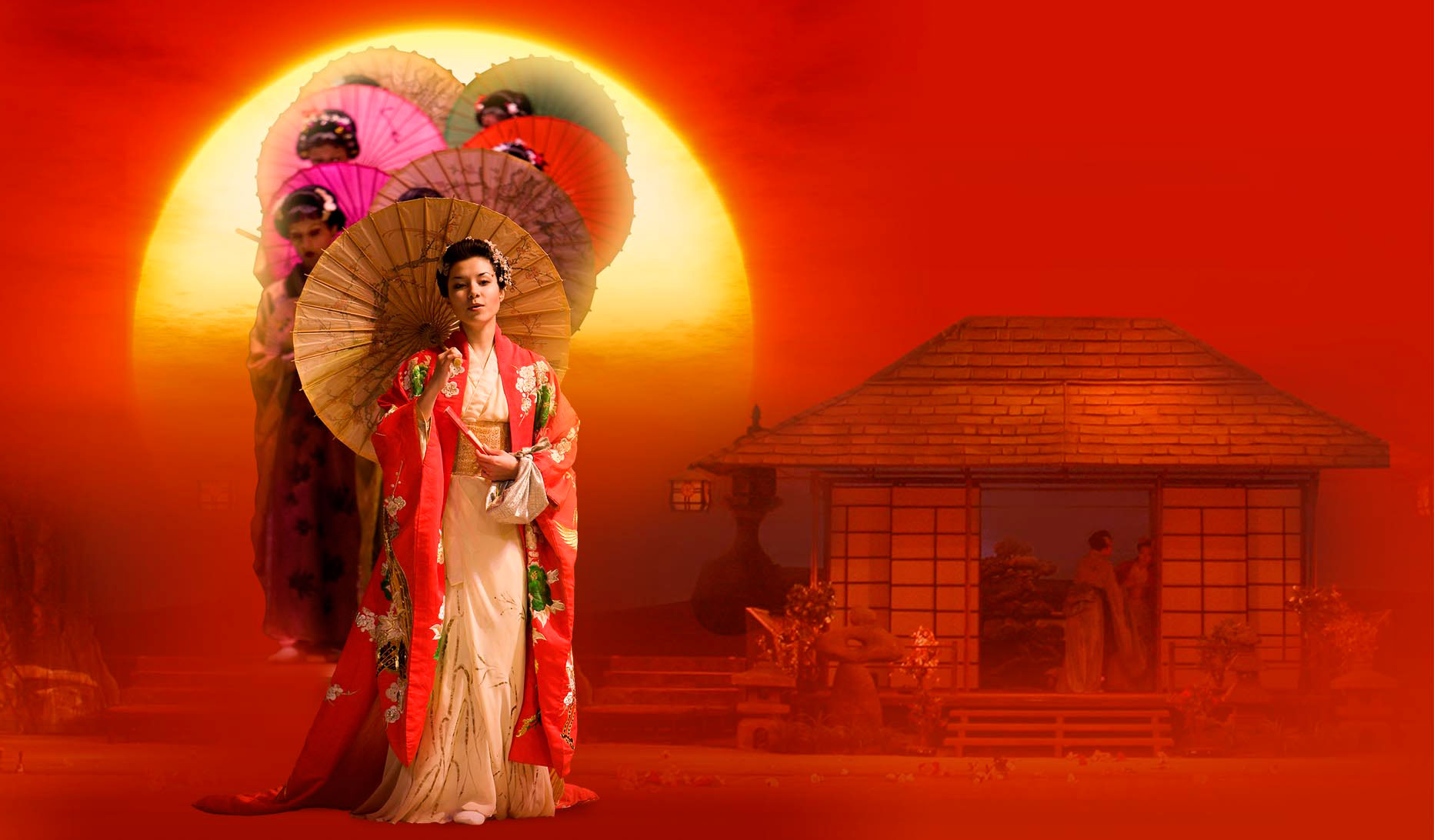
With directors jostling to reinterpret Puccini, Ellen Kent’s Madama Butterfly at the New Theatre, Cardiff was a breath of fresh air—traditional, heartfelt, and free of gimmickry. At a time when many stagings feel the need to modernise, deconstruct, or appease contemporary anxieties, Kent offers something increasingly rare: an unembellished, faithful telling that allows Puccini’s haunting score and tragic narrative to speak for themselves.
There is no ironic detachment or forced cultural commentary here. This is Butterfly as Puccini intended—rooted in 1904 Nagasaki, lovingly crafted in both sound and staging. Kent’s direction brings clarity and sincerity to the story, helped enormously by the beautifully designed set: a traditional Japanese garden complete with a minka (house), trickling water, and delicate cherry blossom. Sliding paper screens are used with clever theatricality, particularly for moments of silhouette and emotional distance. Local children from Stagecoach Cardiff added to the richness of the stage picture, appearing in costume with professionalism and charm, underscoring the community spirit of the production.
Korean suprano Elena Dee shone in the demanding role of Cio-Cio San. Her portrayal grew in emotional depth as the opera progressed, making her final moments all the more devastating. Her Un bel dì vedremo was exquisitely phrased, filled with the quiet desperation of a girl who still believes in love and honour. By her side, Yelyzaveta Bielous was a compelling Suzuki, her warm mezzo bringing both compassion and strength to their shared scenes.
As the callous Pinkerton, Hovhannes Andreasyan gave a vocally confident and dramatically convincing performance. His tenor carried both swagger and subtlety, with moments of lyrical softness that hinted at Pinkerton’s fleeting conscience. Vitalie Cebotari was convincing as the American consul Sharpless, his eloquent baritone bringing both gravitas and moral conflict to the role. Valeriu Cojocaru’s brief but commanding appearance as the Bonze provided a thunderous turning point, and Mihail Moisei’s Prince Yamadori offered a dignified, sympathetic presence.
Underpinning it all was the strong and balanced conducting of Vasyl Vasylenko. The orchestra played with sensitivity and dramatic precision, never overwhelming the singers but always supporting the emotional arc of the score. Vasylenko allowed the music’s Japanese-inflected textures to breathe, bringing out the delicacy in Puccini’s orchestration without ever losing momentum.
What’s most striking is the production’s refusal to apologise for the opera’s origins. Rather than offering a hollowly “correct” revision, Kent’s staging treats the source material with respect and artistic integrity. Puccini’s careful research into Japanese musical idioms is acknowledged and honoured, not buried or rewritten. And perhaps most tellingly, this is probably more what opera audiences want to see being performed than the mind games of some directors.
After the curtain fell, the company assembled to sing the Ukrainian National Anthem. With many of the cast and crew hailing from Ukraine, as member of the Ukrainian Opera and Ballet Company Kyiv, is the the gesture was deeply moving. No explanation was needed—just a moment of solidarity, sincerity, and grace. The standing ovation that followed said everything.
