
***
This is a no-holds barred nightmare of red velvet and megalomania. It is the story of what happens to a family after the death of its head, its Master, Richard Wagner, in attempting to maintain and fulfil his legacy against a backdrop of the darkest days in modern European history.
At its core is a staggering performance from Mark Le Brocq as Houston Stewart Chamberlain, the twisted ideologue who married into the Wagner family and helped cement its poisonous legacy. Yes, we did have, Houston we have a problem, in the libretto.
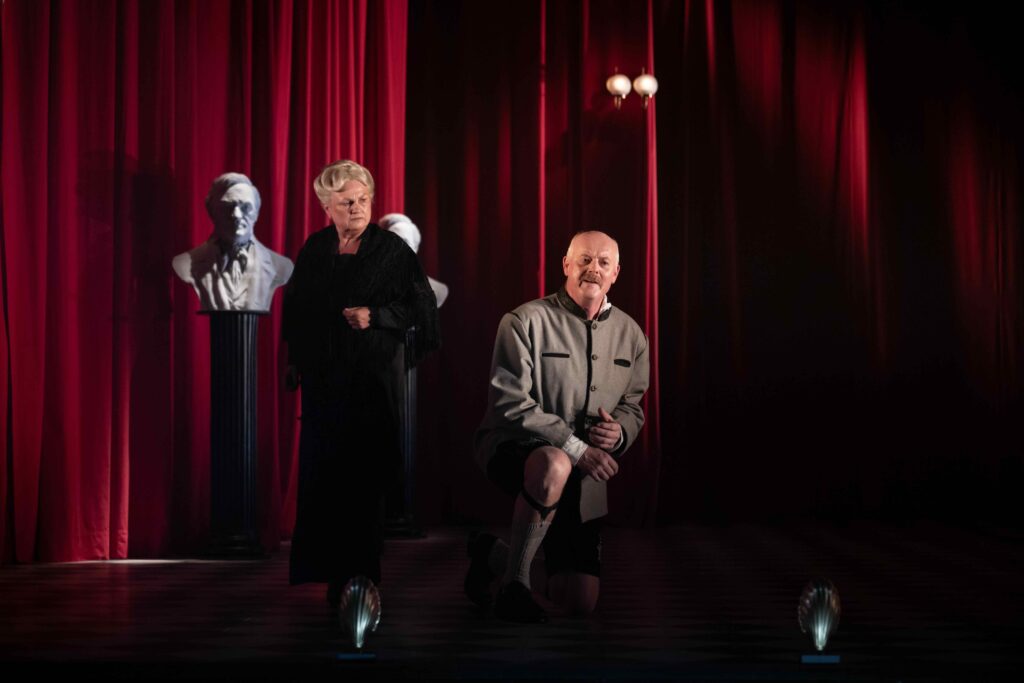
Susan Bullock and Mark Le Brocq
Le Brocq doesn’t just play Chamberlain – he embodies him, in all his grotesque conviction. He’s matched every step of the way by Susan Bullock’s ice-cold Cosima Wagner, chillingly controlled yet fanatical, the keeper of the flame after her husband Richard’s death. Together, they make for a chilling pair – toxic and deluded, their brand of pure blood ideology laid out in ugly clarity.
They are shadowed throughout by the man himself or, more accurately, a fantastical green grimacing cavorting grotesque of the dead Wagner. This Wagner-Daemon acts as an impish yet gross sprite who comments on the ridiculousness of the living characters and ultimately reduces Chamberlain to being a footnote in history.
The narrative of the drama hinges on Cosima’s increasingly unhinged desire to shape the Wagner legacy in her image while convinced it is what the Master would have wanted. Yet this work puts the blame for this largely on the strange Germanophile Englishman Houston Chamberlain who urges her to maintain the purity of the family including casting out her daughter Isolde who is symbolically packed away into a display cabinet and told to reinvent as a true Wagner. Ever present is another display case, this time of the dead butterflies that the failed scientist and master race eugenics devotee Chamberlain has collected. Homosexuality also has to be hidden so Seigfried, Wagner’s son, so unsuited to take the mantle in this increasingly manic cult creation is similarly forced metaphorically into the closet. This angst provided the context for Andrew Watts’s beautiful aria to his lover. That closet includes being forced into a marriage with Winifred, played and sung exquisitely by Alexandra Lowe. It is of course Winifred who becomes devoted to Hitler who joins the cult family and is portrayed as embraced as the hero required to maintain the Master’s legacy. The Fuhrer appears at first as a cross between a clown and First World War soldier, and is redressed in black tie and tails as he joins Germany’s “first family”. He is finely sung by Adrian Dwyer, with accompanying music foretelling the cataclysmic events to follow..
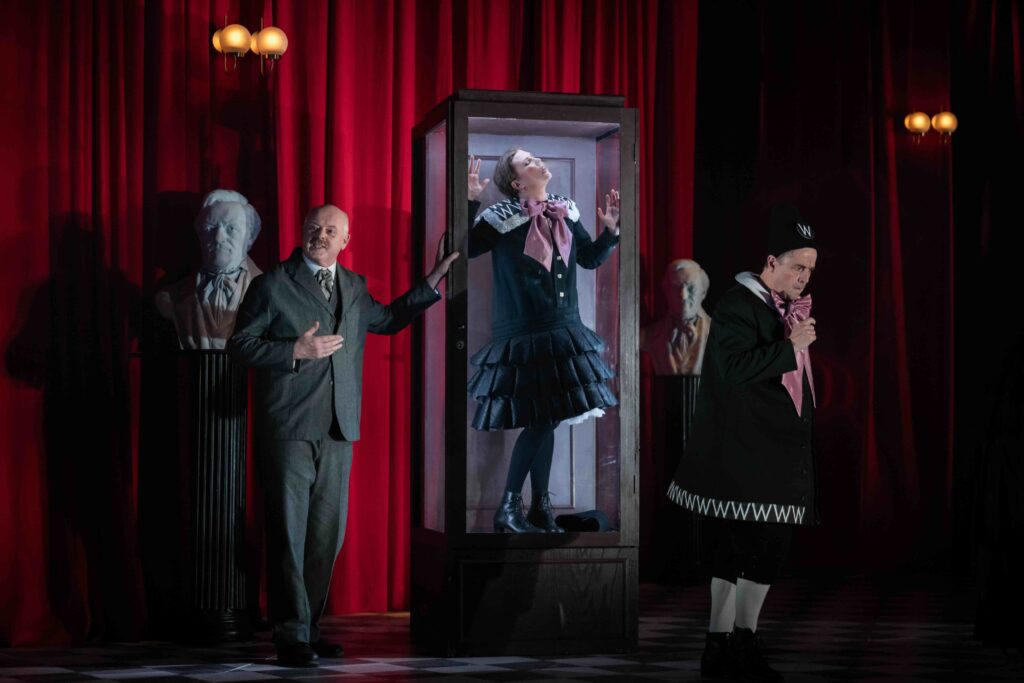
Mark Le Brocq, Alexandra Lowe and Andrew Watts
Some basic knowledge of both Wagner’s life (and death in 1883) and then development of Germany until the rise of Hitler in the 1920s is needed to fully contextualise the family in-fighting and influence of Chamberlain and appreciate the text from librettists Lutz Hübner and Sarah Nemitz. It also enables recognition of certain figures, usually caricatured. The show, structured in 20 short scenes, is detailed and fast paced in the imaginative hands of Polly Graham. There are two distinct acts, with the first stylistically having a Bob Fosse feel, literally Cabaret style with strange characters populating a chaotic theatrical landscape. Then in the second act we enter the red draped, Wagner-busts, shrine that is Wahnfried. It is both a mausoleum and family home, although increasingly a malevolent insane death cult. Avner Dorman’s composition ranged from periods of near madness, heavy on percussion and chaos, while others are graceful and moving, that contribute to this being far more than an opera about the poisonous Wagner dynasty’s infighting over the legendary composer’s legacy.
This is a world poisoned by antisemitism which still haunts that Wagner legacy. Edmund Danon as Hermann Levi, the Jewish conductor who led the premiere of Parsifal at Bayreuth, elegantly haunts the opera embodying the contradictions and delusion of the Wagners in their attitude to the Jewish race.
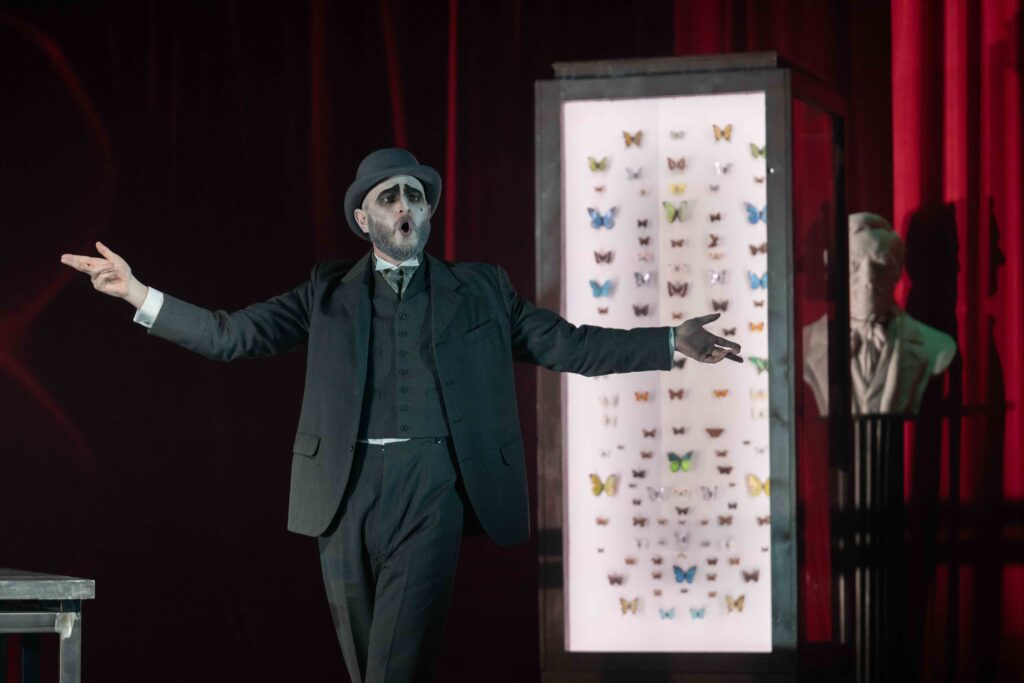
Edmund Danon
But the greatest haunting comes from Oskar McCarthy’s contempt filled Wagner spirit, a green hideous figure who ridicules Chamberlain when the delusional manipulator of this death cult believes he will stand alongside Kant, Goethe, and Wagner.
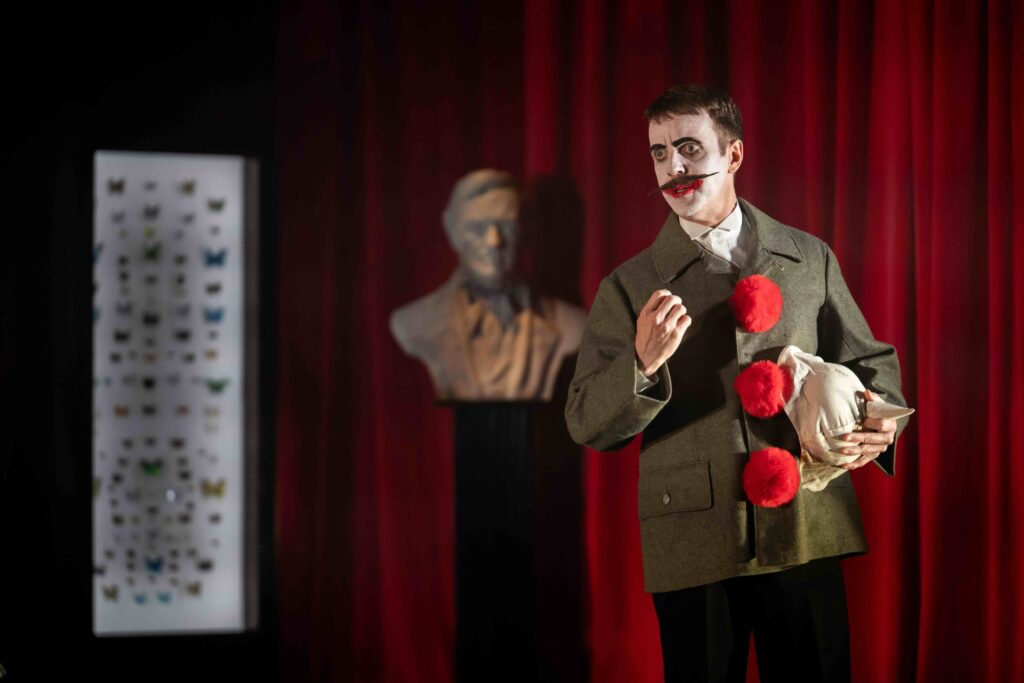
Adrian Dwyer
By curtain call, it was Le Brocq, stepping forward to take his bow, who got the hero’s welcome. However, as the Wagner ghoul notes, none of his heroes succeed. Could it be that even Hitler’s ultimate downfall could be seen as another failed Wagnerian anti-hero, at least in the Wagnerian family and Houston Chamberlain legacy?
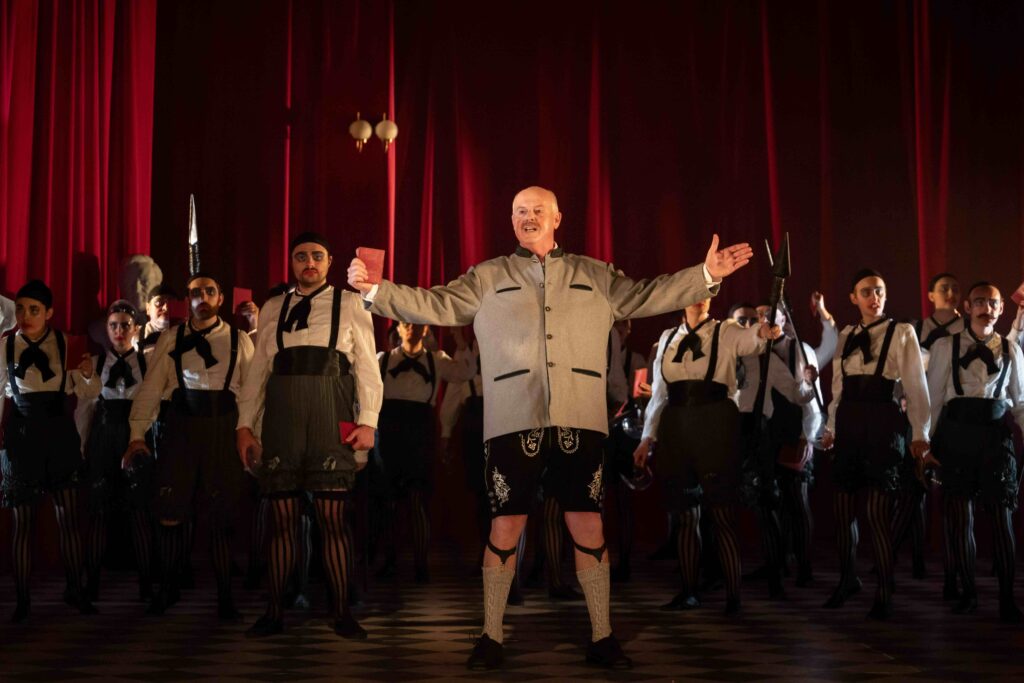
Mark Le Brocq
This isn’t just a history lesson – it’s a searing portrait of ideological obsession, all played out in a world where legacy is everything, and heroes bring about not only their own destruction but like the cavorting anarchist in the opera’s first act, incinerate all around them.
Wagner’s works are still staged in his festival house, and Wahnfried also still survives, in Bayreuth. Yet it also remains a haunted legacy to which this work adds another incarnation and interpretation.
It is also of note that this powerful performance under the baton of Justin Brown with the Longborough Festival Orchestra, forming the work’s UK premier, takes place at this Cotswolds venue that has carved out its fine reputation for Wagnerian work under the specialist Anthony Negus. In 2026 that will continue with their production of Tristan and Isolde, followed by Meistersinger the following year, both being conducted by Anthony Negus.
Main image: Oskar McCarthy
Images by Matthew Williams-Ellis
For tickets: https://lfo.org.uk/opera/wahnfried
Also from Longborough 2025:
Opera Holland Park’s first Wagner with The Flying Dutchman

2 thoughts on “Wagner’s dynastic dystopia Wahnfried UK premier at Longborough”